Kubova
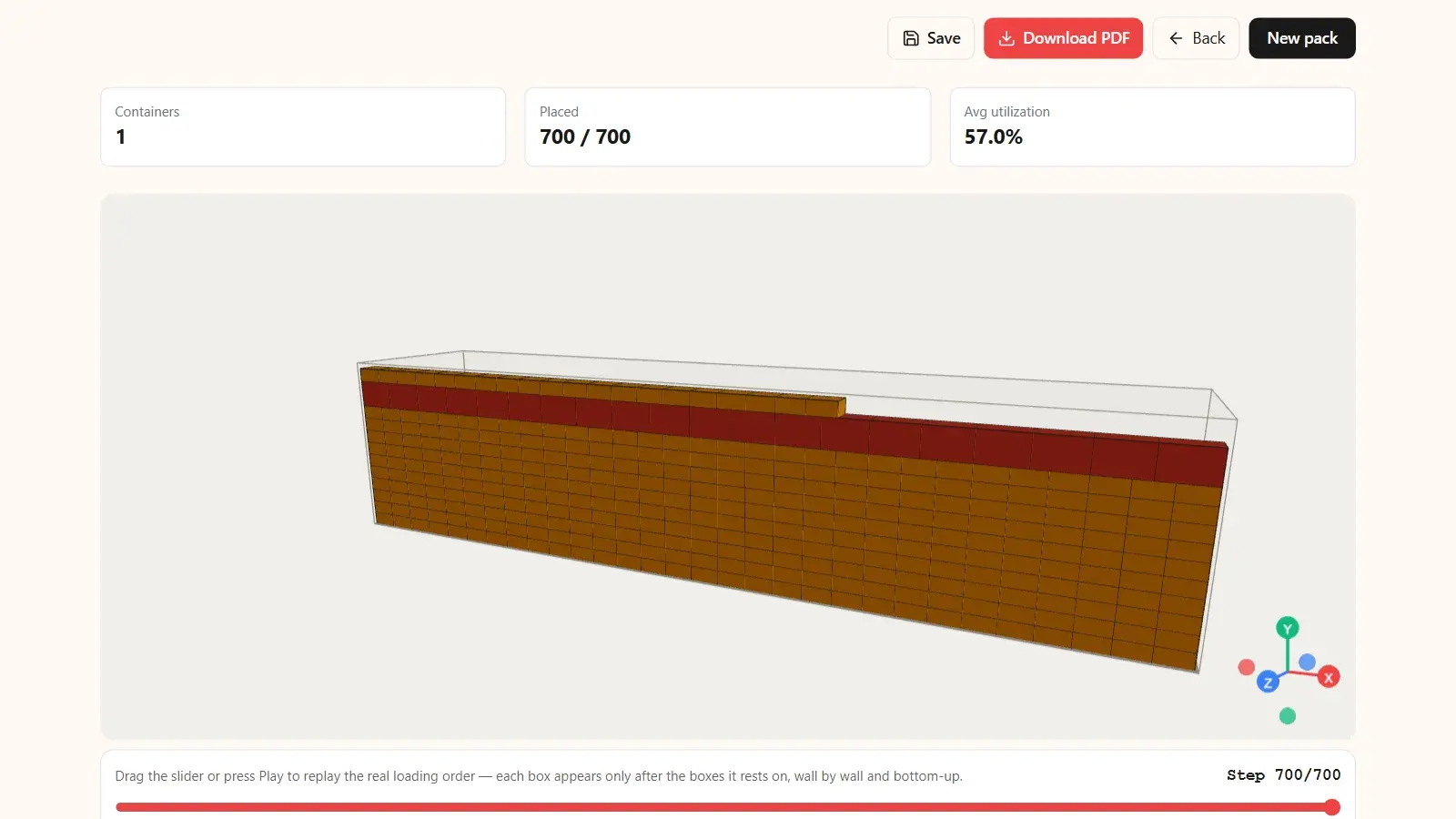
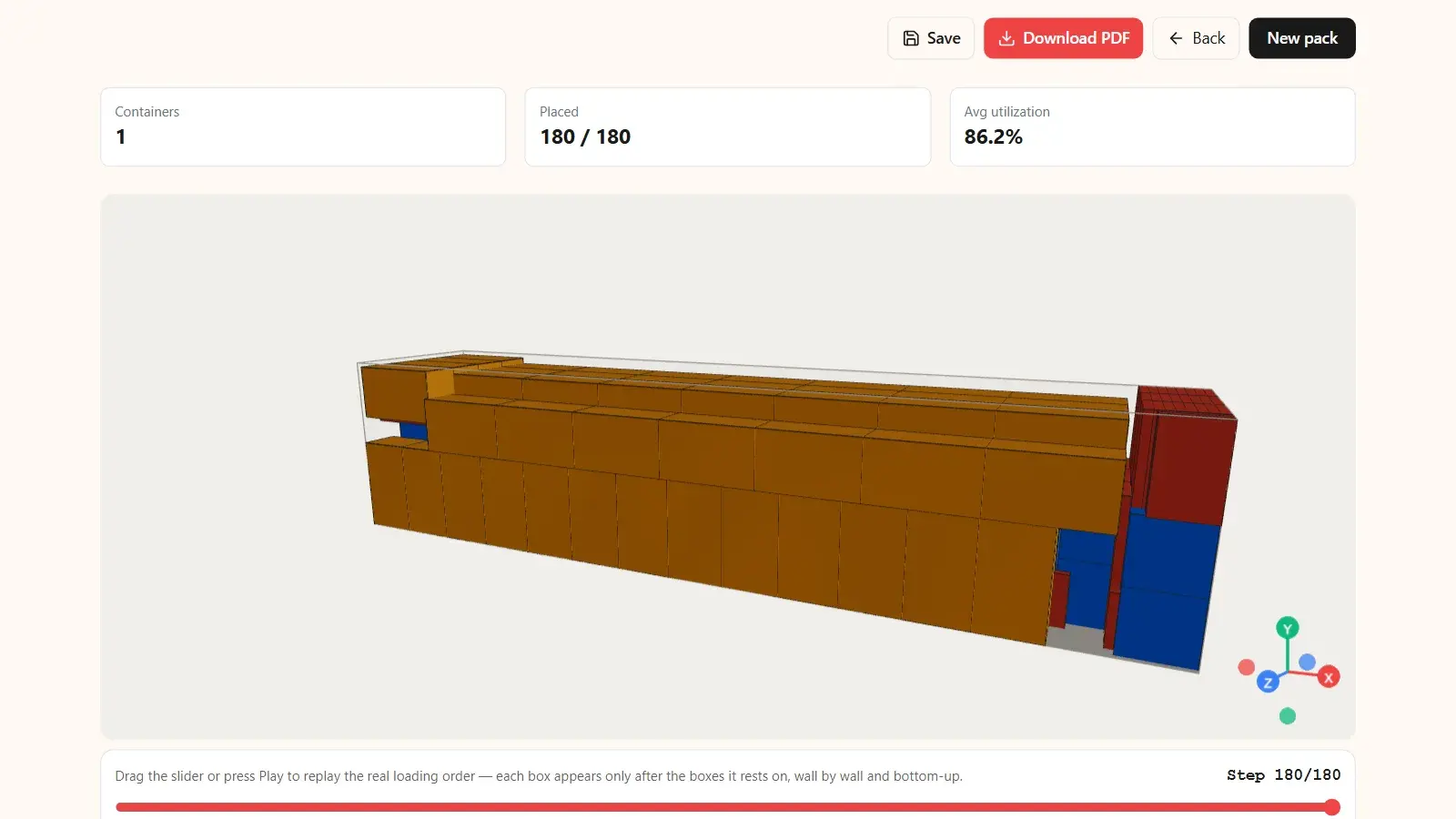
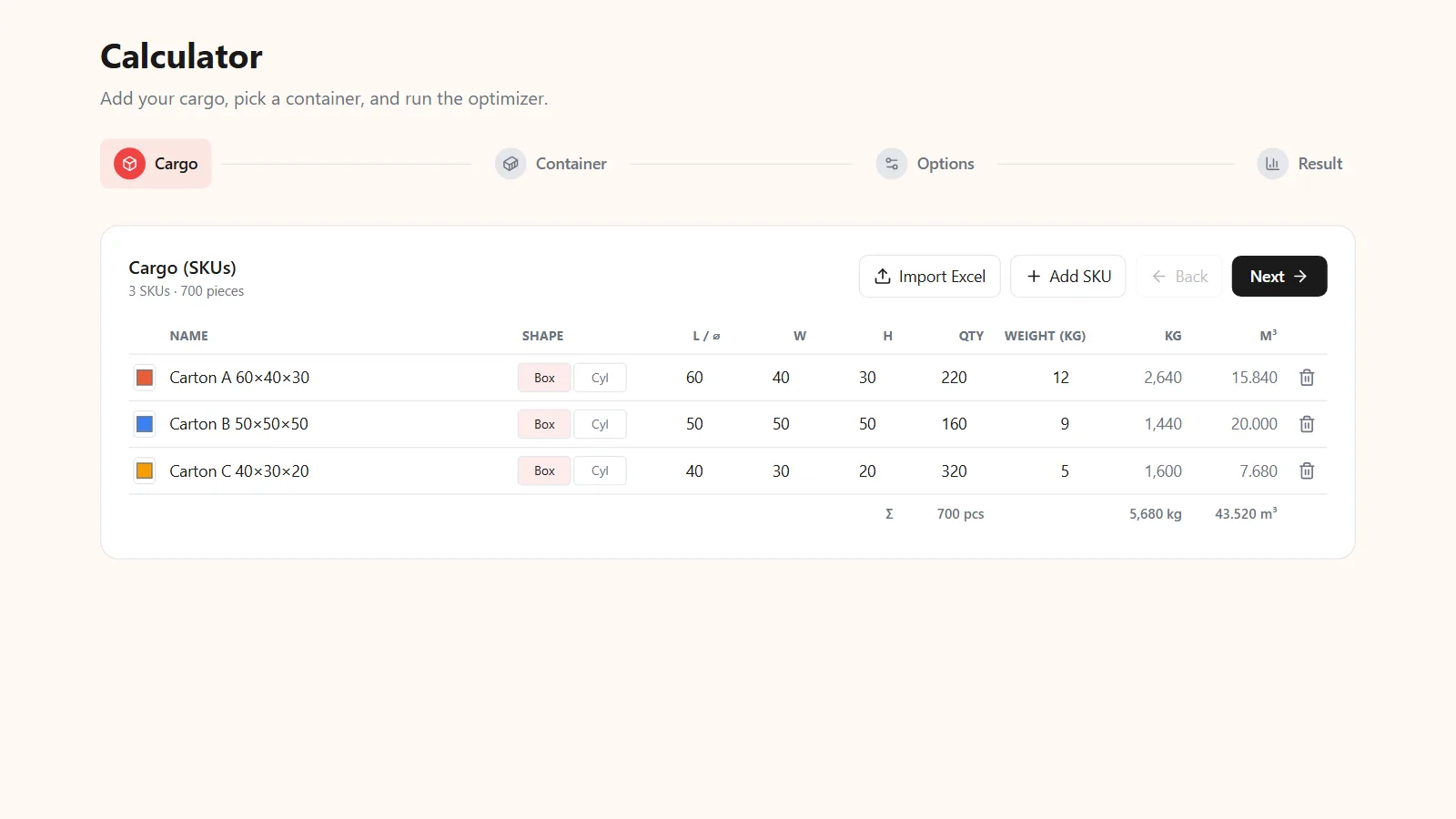
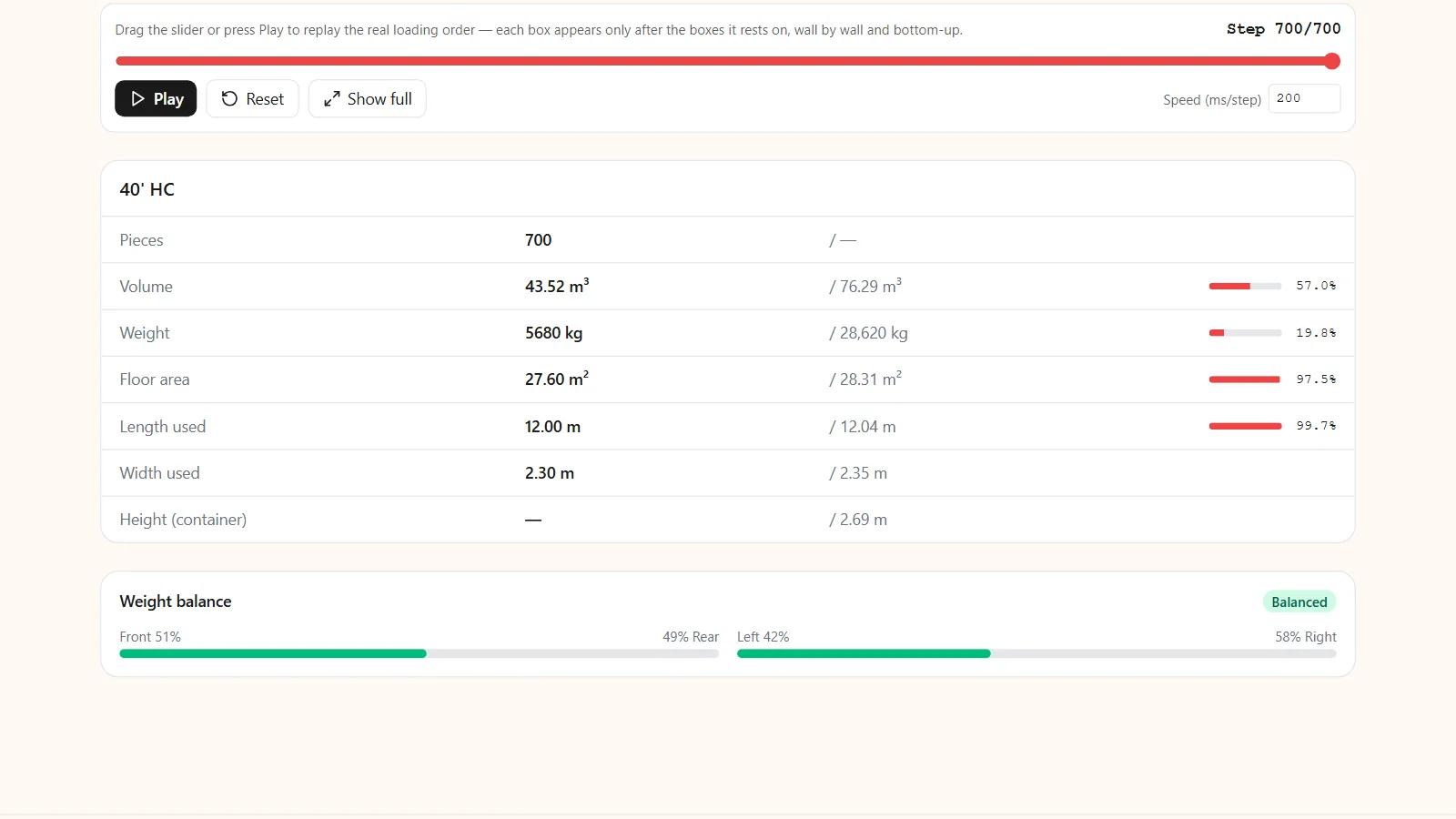
Mixed-SKU container loading: plan every product in one 3D load instead of one SKU at a time. In our engine test (measured 2026-06-08), a three-SKU order of 700 cartons fit into one 40 HC when packed together; loaded one SKU per container, it needed three. Smaller cartons fill the gaps larger ones leave, so a mixed plan often needs fewer containers. Handling and segregation rules still come first.
Real orders are rarely one product. They are a mix of cartons, and how you combine them decides whether they ship in one container or three. Single-SKU calculators can only evaluate one product at a time, which is why they over-book space. This post shows the measured difference, explains why mixing works, where it gets hard, and the rules that should stop you mixing.
One order, two ways to load it
We took a three-SKU order and packed it two ways with the same engine and the same container, a 40 HC:
| Loading method | Containers | What happens |
|---|---|---|
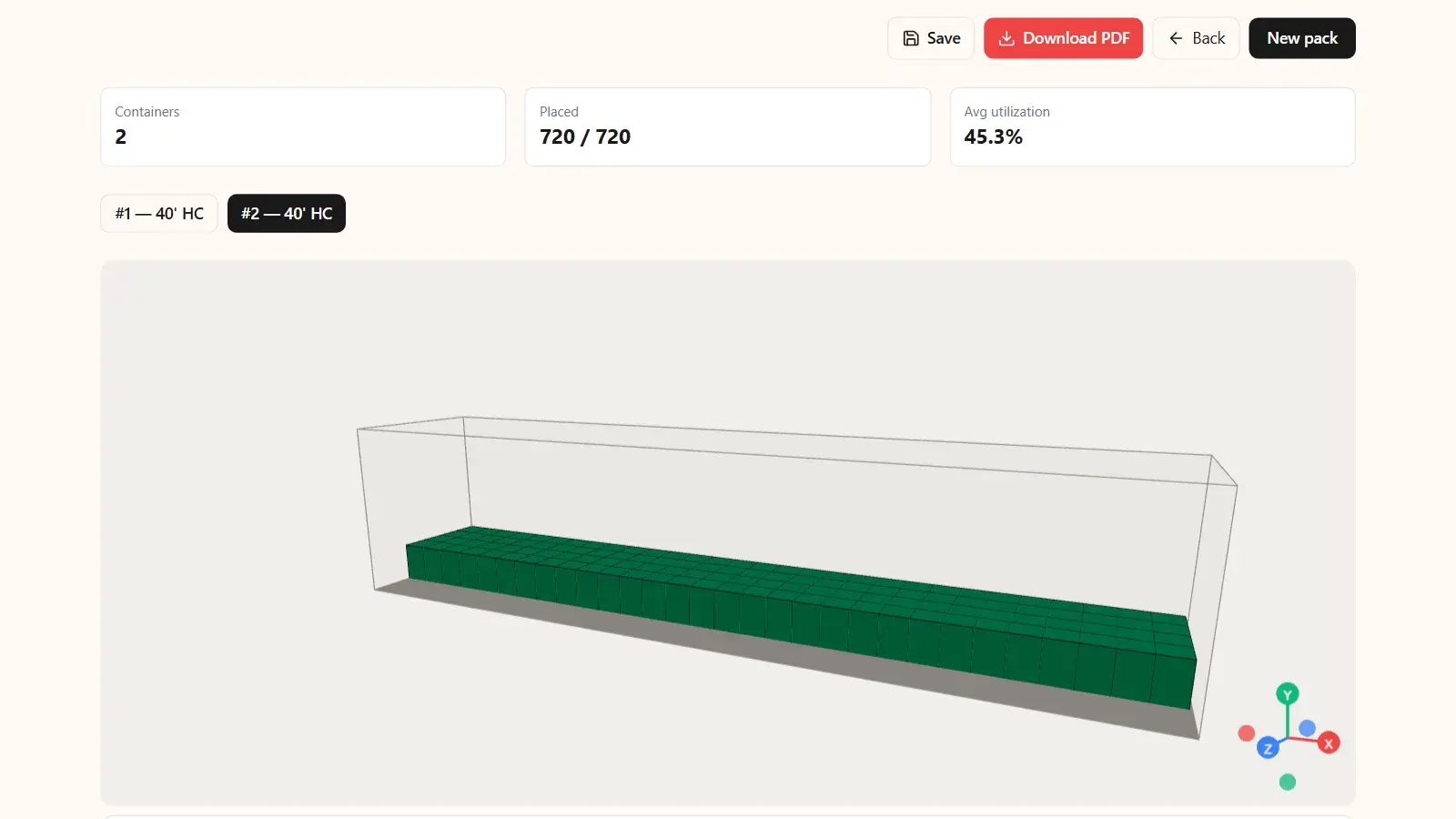
| Loaded separately | 3 containers | Each SKU gets its own container, and each is only 10–26% full by carton volume. |
| Loaded together (mixed) | 1 container | All 700 cartons fit in one 40 HC, using about 57% of its volume. |
Order: 220 × 60×40×30 cm (12 kg), 160 × 50×50×50 cm (9 kg), 320 × 40×30×20 cm (5 kg). Kubova engine, measured 2026-06-08.
The arithmetic behind the percentages: the three SKUs take 15.84 m³, 20.00 m³ and 7.68 m³, together 43.52 m³ and 5,680 kg, against the 76.3 m³ typical inner volume of a 40 HC. This order is small enough that the answer looks obvious once you see the volumes. The point is that a tool which evaluates each SKU alone has no way to give you that answer: it only knows that each product needs "a container".
Why mixing wins
A single carton size leaves a predictable pattern of gaps: the strips along the walls and the partial layer under the roof that its dimensions cannot fill. Different carton sizes fill each other's gaps. The 40×30×20 cartons drop into the spaces the 50 cm cubes leave behind.
Our fill-rate benchmark shows the effect. Each figure is the share of a 40 HC's inner volume the engine filled, measured 2026-06-08, with light unit weights so that only space binds:
| Cargo profile | Volume filled |
|---|---|
| 40×40×40 cm cube only | 75.5% |
| 80×60×50 cm carton only | 89.7% |
| 50×40×30 cm carton only | 90.4% |
| Three sizes mixed (60×40×30, 50×50×50, 40×30×20) | 93.1% |
Two caveats keep this honest. In the mixed run the engine was offered 2,000 cartons of each size and could choose the combination, so 93.1% is a best case; a real order has fixed quantities. And mixing is not the only route to high fill: a single small, well-proportioned carton (40×30×25 cm) reached 97.0% on its own in the same benchmark. Mixing helps most when large cartons leave gaps that only smaller ones can use. More profiles are in the container fill-rate benchmarks.
Where single-SKU math breaks: orders near a boundary
The 1-versus-3 result is the easy case. The hard one is an order that sits close to one container's capacity.
Illustrative example. An order of 400 cartons of 60×40×40 cm and 500 cartons of 50×40×30 cm, light enough that weight does not bind. Measured single-SKU capacities for a 40 HC are 660 and 1,150 cartons. Adding the fractions gives 400 ÷ 660 + 500 ÷ 1,150 = 0.61 + 0.43 = 1.04 containers. The carton volume is 38.4 + 30.0 = 68.4 m³, about 89.6% of 76.3 m³.
Neither number answers the question. The fraction sum assumes each SKU keeps its own gaps and still gets a container-shaped space to fill, so it can miss in either direction. The CBM figure assumes no gaps at all, so it is always too optimistic. Whether this order needs one container or two depends on whether the smaller cartons fill the gaps the larger ones leave, which only a mixed 3D plan can show. Run it before you book the second box; avoiding a second container covers what to do if a few cartons spill.
When not to mix
Mixing is a geometry advantage, but it never overrides handling and compliance. The IMO/ILO/UNECE CTU Code sets out general rules for packing mixed cargoes (Annex 7, 3.2.3):
- Heavier cargo not on top of lighter cargo, and heavy units never on fragile parcels.
- Sharp-edged pieces not on units with weak surfaces, and liquids not on solid cargo.
- Dusty, moist or odorous cargo kept away from goods that soil, absorb moisture or take on odour easily.
- Incompatible cargo in the same container only if it is separated or protected by suitable sheathing.
Two more constraints shape where SKUs go rather than whether they mix. Goods that carriers or authorities may inspect, such as dangerous goods or goods liable to customs duty, should if possible sit at the door end (Annex 7, 3.2.2). And the stowage should allow smooth unloading (Annex 7, 3.2.1), which matters when one container serves several consignees or lots that must stay physically separate.
Within those rules, mix as much as the geometry allows. Furniture is the classic case: a single order can carry a dozen carton sizes with very different fragility (loading furniture into containers).
How to plan a mixed-SKU load
- List every SKU with its outer carton L × W × H, unit weight and quantity.
- Set handling rules per SKU: this-way-up, no-stack, and any limit on what may sit on top.
- Write down the separation rules that apply: incompatible goods, odour or moisture, inspection at the door, consignee or lot separation.
- Plan all SKUs together in one run, not one at a time, and compare the container types you could book.
- Read the result critically: check leftovers, weight against the payload of the actual box, and that the heavy cartons are spread along the length rather than bunched at one end.
- Hand the crew a plan with per-SKU placed-versus-ordered counts (container load plan template).
Common mistakes with mixed loads
- Adding up single-SKU container fractions. The total can be wrong in either direction.
- Trusting total CBM. It ignores the gaps every real layout leaves.
- Closing a gap with the wrong carton. A heavy carton on a crushable one is not a saving.
- Ignoring the unloading order. A multi-consignee container packed purely for density can force the receiver to unload everything to reach one lot.
- Rounding the fill up. A plan at 89% utilization still has about a tenth of the container free; calling it "full" hides space you could use for the next order.
How Kubova handles mixed SKUs
Kubova packs every SKU in a single plan with real 3D packing that never places a box past a container wall:
- Mixed SKUs together. Enter each carton's dimensions, weight and quantity; cylinders are supported too. Set stacking and rotation rules per item, including "this side up".
- Containers and pallets. Choose a 20ft, 40ft or 40HC container or custom dimensions, with standard or custom pallets, and get a multi-container plan when one box is not enough.
- Honest results. Units loaded, volume utilization and weight against the payload limit, with leftover units reported instead of a fake 100%. Every box has exact coordinates in the interactive 3D view.
- Sets. The capacity tool tells you how many complete sets of one or more carton types fit per container and which limit binds.
- Hand-off. Save packs, reopen them and download a PDF load plan. The Pro plan adds the REST API and an MCP server, through which an AI assistant such as Claude or ChatGPT can read a packing-list spreadsheet, PDF or photo and call Kubova for you.
Start with the calculator.
Sources & method
- Measurements: the 1-versus-3 result and the fill-rate table are direct outputs of the Kubova packing engine, measured 2026-06-08, in a 40 HC with the engine's typical inner dimensions (76.3 m³). The single-SKU runs and the mixed fill run used light unit weights so that volume was the binding limit; the 1-versus-3 order used the weights shown. The fraction-sum case is an illustrative example built on the measured single-SKU capacities, not a measured mixed result.
- IMO: CTU Code overview, the joint IMO/ILO/UNECE non-mandatory code of practice for packing cargo transport units (2014).
- CTU Code full text, MSC.1/Circ.1497, Annex 7 (Packing and securing cargo into CTUs), sections 3.2.1 to 3.2.3, for the mixed-cargo stowage rules.
- Maersk: cargo weight limit by container type, which lists a 76.4 m³ capacity for its 40' high cube and notes that limits vary by country. Inner dimensions and payloads differ by carrier and box; check the figures for the container you are booked on.