Kubova
Loading furniture into containers: the biggest lever is knock-down versus assembled, because flat panels pack far denser than assembled pieces full of air. After that, plan with the real outer carton size including protrusions, set no-stack and this-way-up rules per item, plan every carton size together as one mixed load, and fill or brace the gaps irregular shapes leave. Then check weight against the payload and keep heavy pieces low and centred.
Furniture is the cargo that breaks tidy loading math. Irregular shapes, fragile surfaces, cartons in a dozen sizes and the assembled-versus-flat-pack question all decide whether an order ships in one container or two, and whether it arrives undamaged. This guide covers the decisions that change the container count, the packing and securing rules of the international code of practice for container packing, a step-by-step procedure, and the mistakes behind most damage claims.
Why furniture defeats a box calculator
A simple "how many boxes fit" calculation assumes uniform, stackable, rotatable cartons. Furniture breaks all three assumptions:
- Irregular shapes. Arms, legs, curved backs and protrusions mean the shipping carton is not a clean rectangle, and void space appears around every piece.
- Many carton sizes. One order can contain a dozen carton dimensions, which is exactly the mixed-SKU loading case a single-box tool cannot plan.
- Fragility and orientation. Glass tops, veneers and upholstery force no-stack and this-way-up rules that remove the orientations a packer would otherwise use.
Volume arithmetic still matters as a first check (how to calculate CBM covers it), but for furniture it is a ceiling, not a forecast.
The one decision that dominates: knock-down vs assembled
Knock-down (flat-pack) furniture ships as dense, rectangular panels that tile a container well. The same product assembled is mostly air: a finished armchair or dining chair is a box of empty space around a frame.
Illustrative example. An assembled dining chair in a 60 × 55 × 95 cm carton takes 0.3135 m³. The same chair knocked down into a 95 × 50 × 18 cm carton takes 0.0855 m³, which is 27% of the space, or about 3.7 times as many chairs per cubic metre. Packing losses apply to both cartons, so container counts will not follow the ratio exactly; run both carton sizes through a real 3D pack before you decide.
If the product can ship knock-down without hurting build quality or driving up returns, it is almost always the largest single saving on loading cost. Where assembly at destination is not an option, design the carton to minimise the void around the piece.
Measure the carton, not the product. Furniture cartons routinely carry feet, corner protectors and irregular bulges that add a few centimetres to the nominal size. Plan with the outer dimensions the warehouse actually handles. A few unaccounted centimetres per carton, multiplied across a load, is the difference between one container and two.
What the CTU Code says about packing furniture
The IMO/ILO/UNECE Code of Practice for Packing of Cargo Transport Units (the CTU Code) is the international reference for packing and securing cargo in containers. It is a non-mandatory code of practice, but it is the joint guidance of all three UN bodies and can serve as a reference for national rules. The rules that matter most for furniture:
| Risk | What the CTU Code says | What to put in the plan |
|---|---|---|
| Crushed fragile pieces | Heavy units should not go on top of fragile parcels; sharp-edged pieces not on units with weak surfaces (Annex 7, 3.2.3) | Flag glass, stone and upholstered cartons no-stack; keep legs and frames off soft cartons |
| Collapsing stacks | Packages in a stack must support those above them; a marked maximum stacking height should not be exceeded (Annex 7, 1.5 and 1.6) | Set a stacking limit per item from the carton rating, not from the container height |
| Shifting cargo | When cargo is blocked, voids should be filled; the sum of voids in any horizontal direction should not exceed 15 cm, and material that deforms, such as low-strength foam, should not be used (Annex 7, 2.3.6) | Plan dunnage or bracing for the gaps instead of loose foam |
| Unbalanced container | Centre of gravity close to mid-length and mid-width: eccentricity no more than 5% in general, as a rule of thumb 60% of the cargo mass within 50% of the length (Annex 7, 3.1.4); vertical centre of gravity below half the cargo-space height (Annex 7, 1.11) | Heavy pieces such as stone tops and solid-wood tables on the floor, spread along the length |
| Door-end collapse | Doors count as a boundary only if cargo is stowed so it cannot strike them or fall out when opened (Annex 7, 4.2.5); dunnage bags not at the doorway without precautions (Annex 7, 2.3.8) | Build a stable final face and brace the door end |
| Moisture damage | Wood products should be packed "container-dry"; the mould threshold is 75% relative humidity; ordinary cardboard loses up to 75% of its stability as humidity rises from 40% to 95% (Annex 3, 4.4 and 4.5) | Pack dry goods on dry pallets; use wet-strength cartons on long routes |
| Rejected wood packaging | Cargo and securing materials should comply with ISPM 15 where applicable (chapter 9, 9.1.1 and 9.2.1) | Check every raw-wood crate, pallet and dunnage piece |
Two details are easy to miss. First, desiccants do not rescue cargo that was packed wet: the Code notes that drying agents in a container of hygroscopic cargo that is not container-dry will generally fail for lack of capacity. Second, wet timber planks, bracing and pallets should not be used at all (Annex 7, 1.4).
Step-by-step: plan a furniture container load
- Decide knock-down or assembled per SKU. Do it before anything else, because it changes every carton dimension downstream.
- Measure and weigh the real cartons. Outer dimensions at the widest points, rounded up to the next centimetre, plus the gross weight of each carton.
- Set handling rules per item. This-way-up for anything with a vulnerable face or hinge, no-stack for glass and stone tops, and a stacking limit for everything else, taken from the carton marks and rating.
- Decide what the order counts. If you sell sets (a table and six chairs), the useful question is how many complete sets fit, not how many cartons.
- Plan every carton together. Heavy, sturdy pieces on the floor and spread along the length; light and fragile items on top; small cartons such as hardware and cushions in the gaps the large pieces leave.
- Check both limits. Total weight against the payload of the actual container, which varies by carrier and box, and volume against the real 3D layout. Dense items such as marble tops can hit the weight limit first (volume vs weight).
- Plan the gaps and the door end. Mark where dunnage or bracing goes and how the last bay is secured.
- Check moisture and wood packaging. Container-dry goods and pallets, wet-strength cartons where the route is long or humid, ISPM 15 compliance for raw-wood packaging.
- Hand the crew a plan they can load from. Counts, weights, a layout view and handling notes, as in this load plan template.
Common furniture loading mistakes
- Planning with catalogue sizes. The product dimension is not the carton dimension.
- Planning one SKU at a time. It hides the space small cartons could recover between large pieces.
- Filling gaps with soft material. Loose cushions and low-strength foam compress in transit and the load starts moving.
- Stacking to the ceiling because the volume allows it. The carton's stacking strength, and how it changes in humid air, sets the limit.
- Using damp pallets or timber bracing. Wet wood raises the humidity inside a closed container and feeds mould.
- Walking straight into the container at destination. The CTU Code warns that furniture and similar goods can emit harmful substances after long voyages, so the container should be ventilated before anyone enters (chapter 12, 12.1.6). It also lists timber and cane furniture among the cargoes most likely to have been fumigated (Annex 5, 4.1.2.2).
How Kubova handles a furniture load
Kubova plans the cartons you enter as rigid boxes (or cylinders, for rolled items) in real 3D:
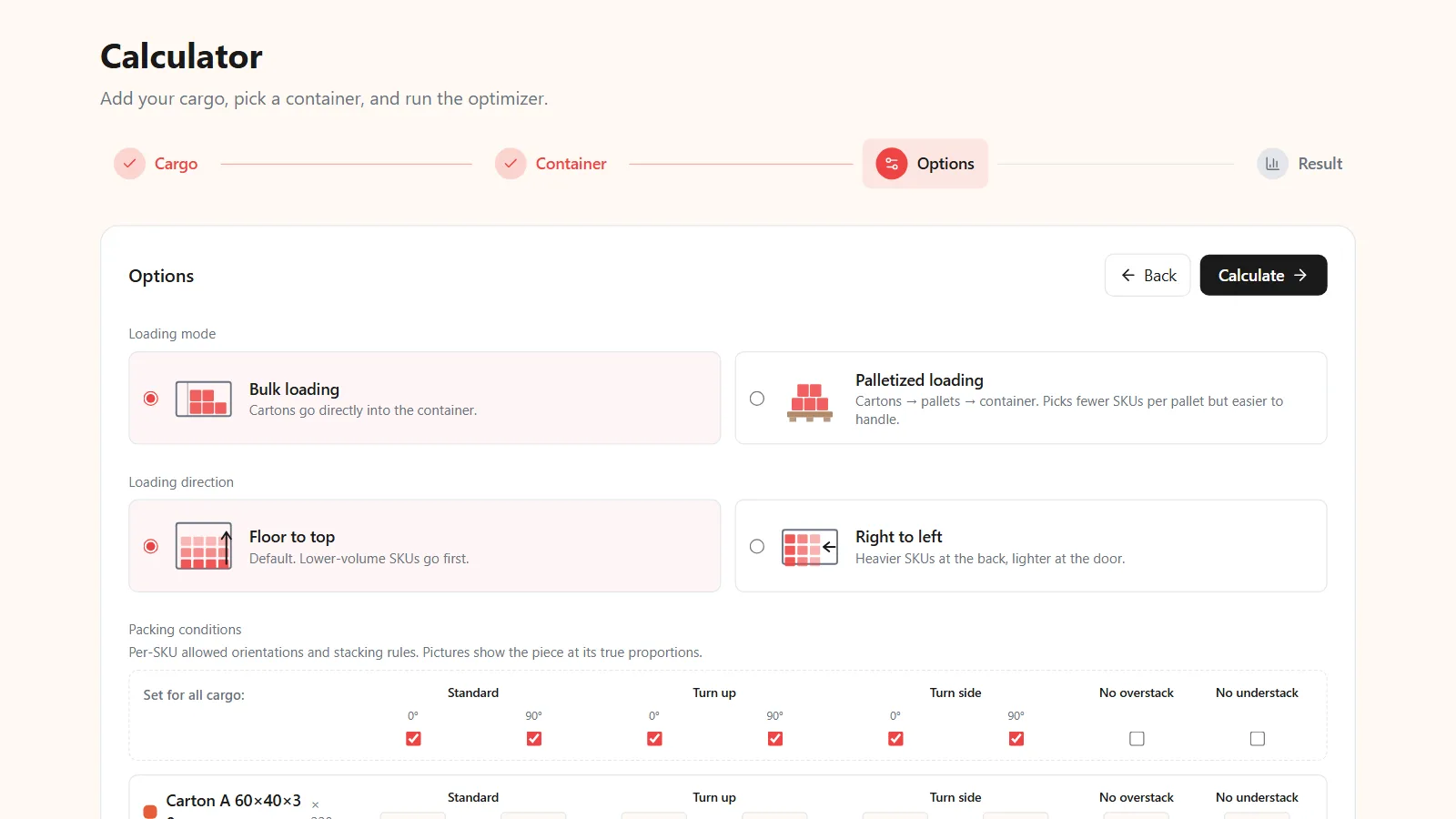
- Per-item rules. Enter each carton's L × W × H in cm, weight and quantity, then set stacking and rotation rules per item, including "this side up".
- Mixed sizes in one plan. Every carton size is packed together, across several containers if needed, and units that do not fit are reported as leftovers rather than hidden behind a fake 100%.
- Sets, not just cartons. The capacity tool answers how many complete sets, such as a table plus six chairs, fit per container and which limit binds first.
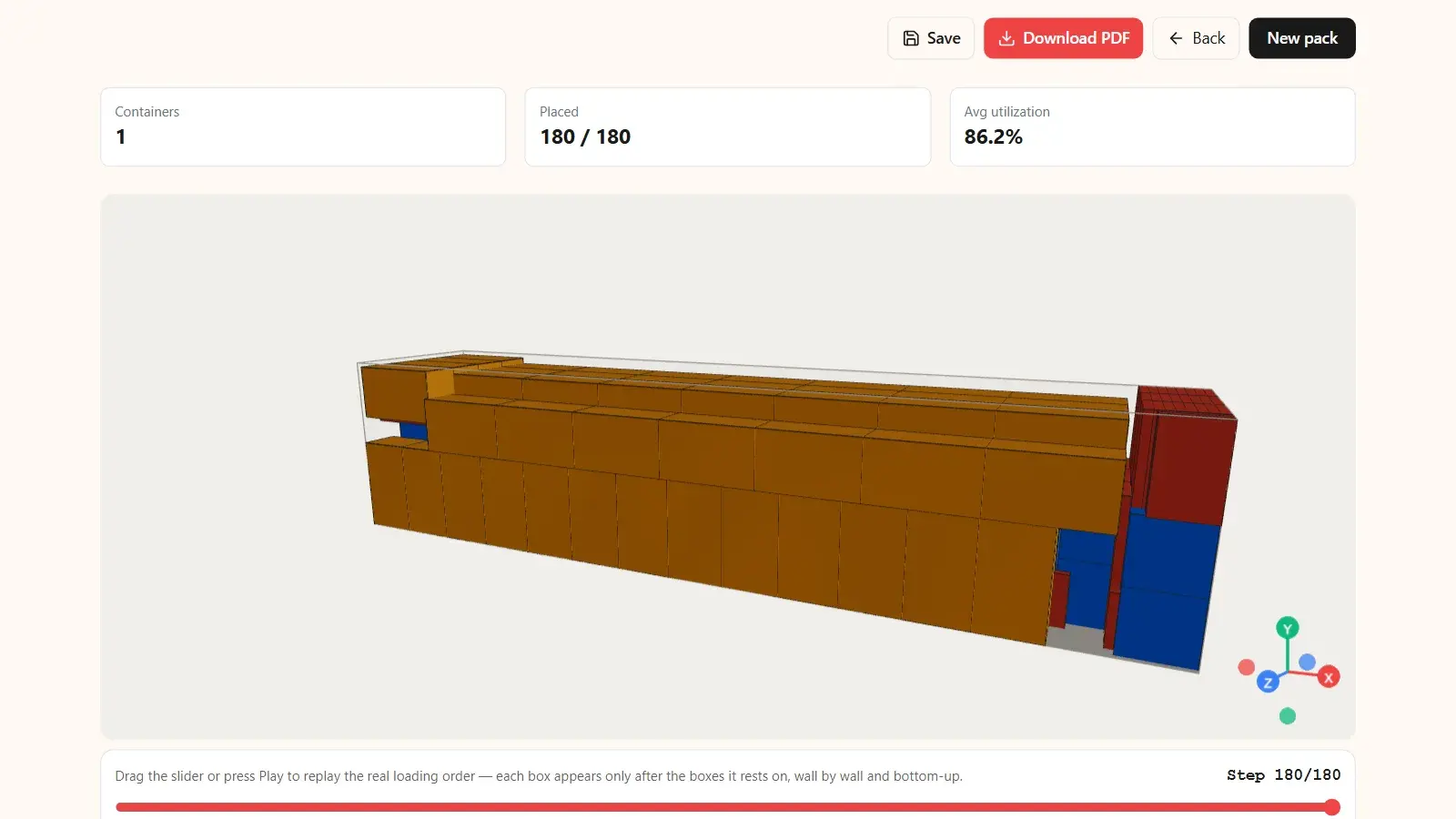
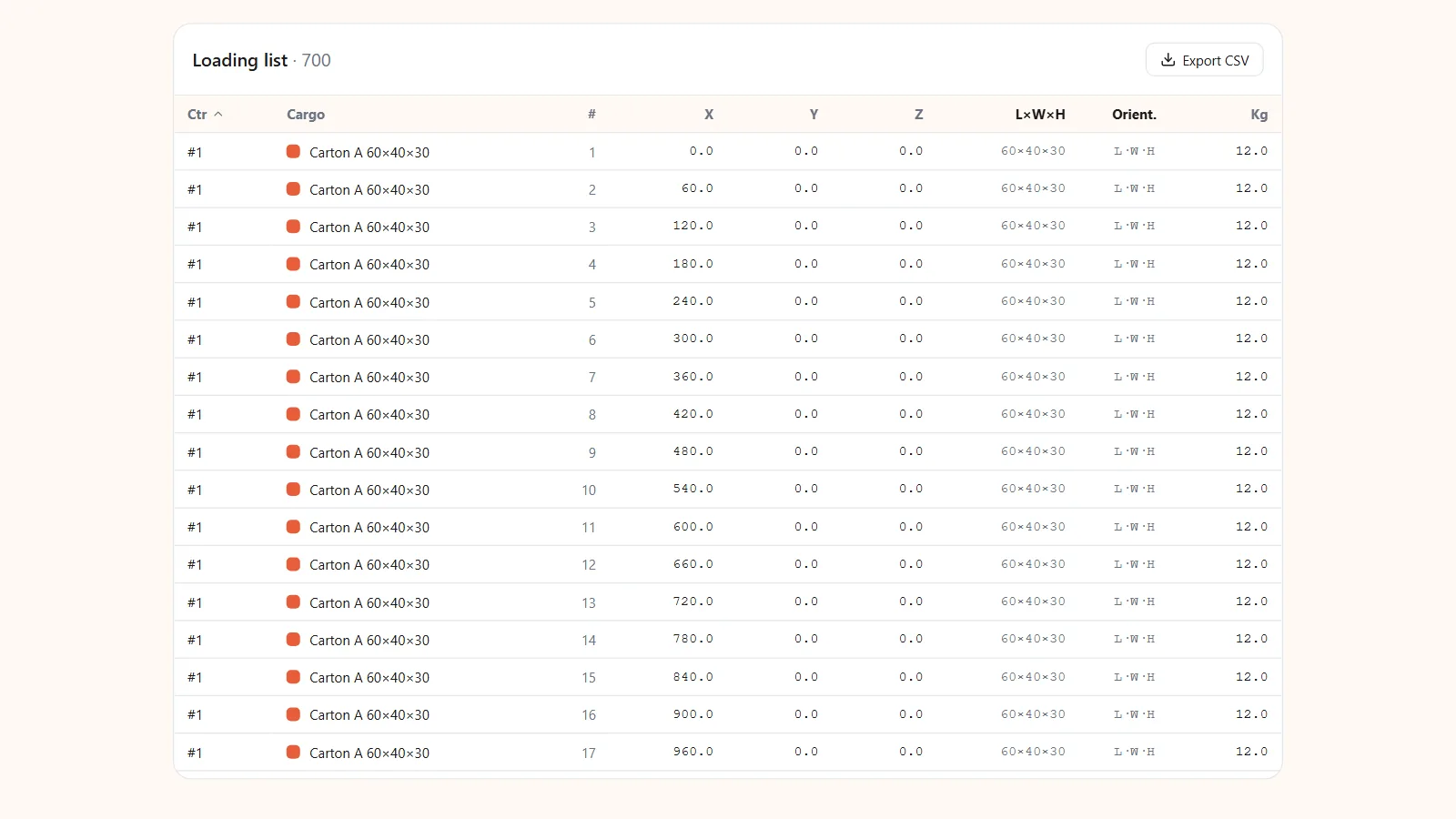
- Weight and space together. The result shows units loaded, volume utilization and weight against the payload limit in an interactive 3D view where every box has exact coordinates.
- A plan for the crew. Save the pack to your dashboard and download a PDF load plan with 3D views, counts, utilization and weight.
What it does not do: design lashing or dunnage, or model an unboxed piece's true outline. Enter unboxed items by their bounding box, and if you want to reserve room for door-end bracing, enter a custom container a few centimetres shorter. Try it in the calculator.
Sources & method
- IMO: CTU Code overview, the joint IMO/ILO/UNECE non-mandatory code of practice (2014), issued as MSC.1/Circ.1497.
- CTU Code full text, MSC.1/Circ.1497. The section numbers above refer to this text: chapter 9 (packing planning), chapter 12 (unpacking), Annex 3 (Prevention of condensation damages), Annex 5 (Receiving CTUs) and Annex 7 (Packing and securing cargo into CTUs).
- IPPC: ISPM 15, Regulation of wood packaging material in international trade, for the scope of the wood-packaging rule, including the plywood exclusion.
- Maersk: cargo weight limit by container type, which notes that weight limits vary by country. Container payloads and inner dimensions differ by carrier and box, so check the figures for the container you are booked on.
The chair comparison is an illustrative example: the volumes are plain arithmetic on the stated carton sizes, not an engine measurement.