Kubova
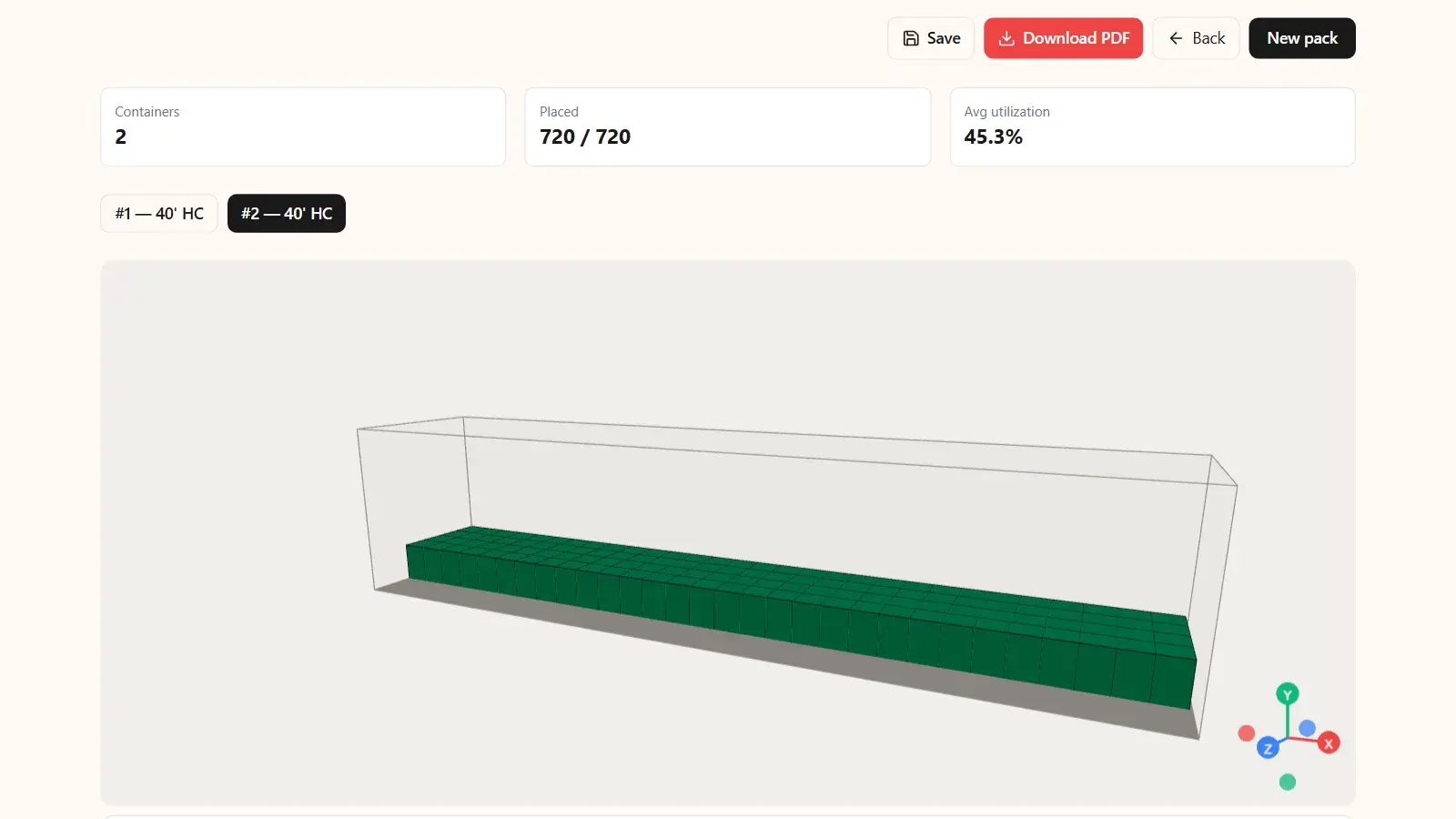
How to avoid a second container: when a load spills just past one box, the second container is mostly air. In five engine runs it was only 10.1–25.2% full, 16.6% on average. You avoid it by changing inputs you control (rotation rules, container type, SKU mix, pallet base), not by re-running the same plan. If you are genuinely out of volume or over the payload limit, the second container is necessary, not waste.
FCL freight is priced per container, so a load that spills just past one box means paying a full rate to carry a few cubic metres. Below: how empty that second box really is, how to tell which limit stopped you, the levers that pull a load back, a worked example, and a five-step check to run before you book.
The second container is usually mostly air
We sized five single-SKU loads of 60×40×40 cm cartons to spill just past a single 40 HC and measured how full the second container ended up. None came close to full:
| Engine run | Second container filled | Empty space in it |
|---|---|---|
| 1 | 10.1% | 89.9% |
| 2 | 12.6% | 87.4% |
| 3 | 15.1% | 84.9% |
| 4 | 20.1% | 79.9% |
| 5 | 25.2% | 74.8% |
| Average | 16.6% | 83.4% |
Single-SKU 60×40×40 cm loads, 5 kg per carton, 40 HC, Kubova engine, measured 2026-06-08.
At the average fill, the second 40 HC carries about 12.7 m³ of cargo (16.6% of 76.3 m³) at a full container rate. The other 63 m³ or so is air you pay to ship.
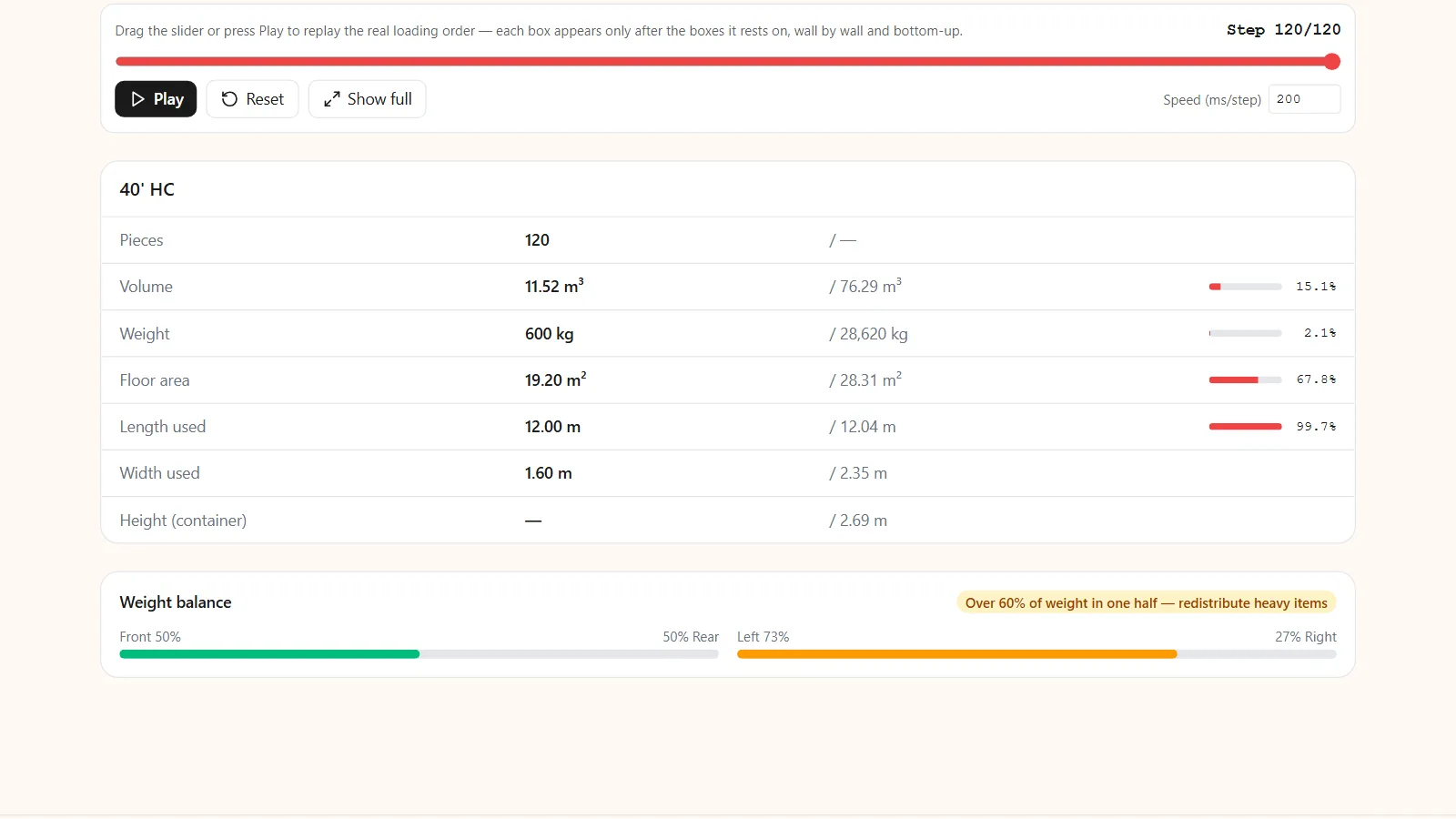
Why loads spill: what stopped the plan
Most surprise spills start with a CBM estimate. Dividing container volume by carton volume assumes cargo pours like liquid. For the same 60×40×40 cm carton, that formula says 794 fit in a 40 HC; the engine placed 660, so the formula overstated by 16.9%. Across six carton sizes the average overstatement was 12.8%, and 20.7% for a 30 cm cube (measured 2026-06-08; full table in how many boxes fit in a 40ft container). If you booked one container on CBM arithmetic, a spill of a few percent is exactly what to expect.
Every spill has one of four causes, and only two of them can be planned away:
| What stopped you | How to spot it | Can re-planning fix it? |
|---|---|---|
| Volume (geometry) | Weight is well under the payload; the leftover is a small share of the order | Often: rotation, container type, SKU mix, pallets |
| Your own loading rules | Items marked "this side up" or "do not stack" leave gaps beside or above them | Often, if the rule is not really needed |
| Weight | Cargo density above about 375 kg/m³ in a 40 HC (425 in a 40 DC, 850 in a 20 DC) | No: only less weight or another container |
| Item size | A piece exceeds the interior or door in every allowed orientation | Not by re-arranging: the piece needs a container type it fits |
The density figures are payload divided by inner volume for typical boxes; the reasoning is in volume vs weight: which limit hits first.
Seven levers that pull a load back into one container
A good engine already returns its best geometry for the inputs you gave it, so you do not consolidate by re-running. You consolidate by changing the inputs:
- Relax rotation rules you don't need. Every "this side up" you can safely drop gives the planner more orientations to close gaps. Fine for robust, orientation-neutral goods such as folded textiles or flat-pack; not for liquids, appliances, or anything the supplier has marked.
- Allow stacking where the cartons can carry it. A "do not stack" flag reserves all the height above that item. Lift it only if the carton's stacking strength supports the weight that will sit on it.
- Change the container type. A 40 HC has about 76.3 m³ inside against about 67.7 m³ for a 40 DC, roughly 8.6 m³ (12.7%) more (typical values; check your carrier). If you planned a 40 DC and your cartons can use the extra height, the High Cube may absorb a spill of a few percent. A 40 HC plus a 20 DC can also beat two 40s; see 20ft vs 40ft: which to choose.
- Mix SKUs in the same container. Small cartons fill the gaps large ones leave. In our runs a three-SKU mix reached 93.1% of a 40 HC, against 75.5–90.4% for single-SKU loads (measured 2026-06-08). More in mixed-SKU container loading.
- Rethink the pallet base, or floor-load. Pallet decks and the gaps between pallets cost space, and a base that tiles the container floor badly costs whole positions. The same carton ranged from 51 to 80 per pallet depending on the base (see boxes per pallet). Floor-loading recovers the pallet space at the price of slower handling.
- Move the spill instead of shipping air. If what is left is small, defer it to the next sailing, ship it as LCL (the FCL vs LCL threshold), or book a 20 ft for it: the average spill above (12.7 m³) would fill about 38% of a 20 DC with 33.2 m³ inside, rather than 16.6% of a 40 HC.
- Fix the carton for next time. Proportions matter: a 30 cm cube reached 79.3% of a 40 HC while a 40×30×25 cm carton reached 97.0% (measured 2026-06-08). If you can influence packaging, a flatter rectangular carton wastes less space.
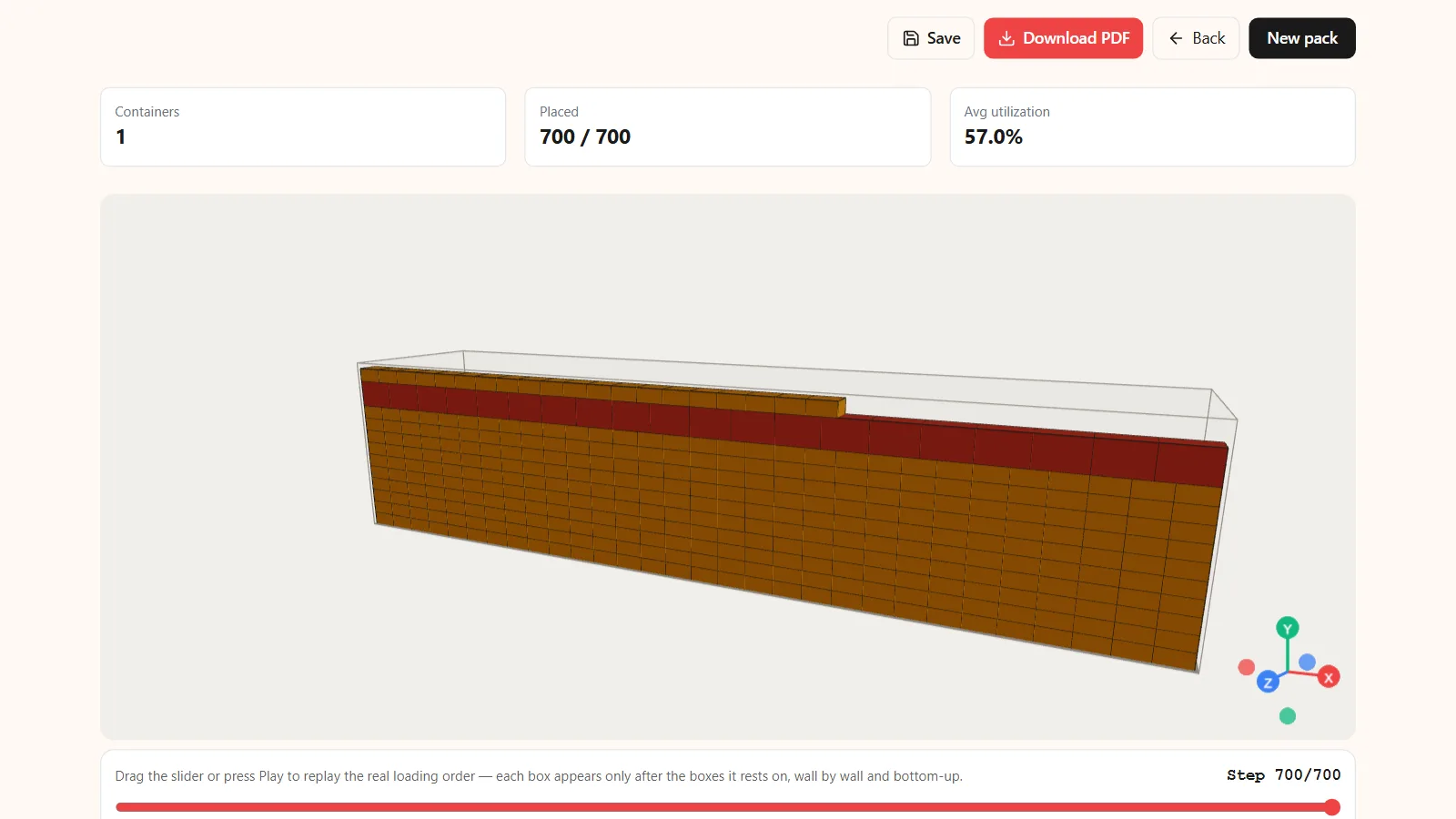
Worked example: one spill you can fix, one you can't
Illustrative example: the numbers are invented to show the arithmetic, not taken from an engine run.
Case A, volume-bound. An order of 68 m³ of cartons in three SKUs, 12,900 kg in total, is booked into one 40 HC (about 76.3 m³ and 28,620 kg payload, typical). The plan loads 64.2 m³, or 84.1% of the container, and leaves 3.8 m³ over.
- A second 40 HC would be 3.8 ÷ 76.3 = 5.0% full.
- Density is 12,900 ÷ 68 = 190 kg/m³, about half the 375 kg/m³ crossover, so weight is not the problem. Volume and rules are.
- Fixes, in order: drop the "this side up" flag on the SKU that only carried it by default, let the lightest SKU stack, and re-plan. If 3.8 m³ still will not fit, it is a textbook LCL or next-sailing candidate, not a second 40-footer.
Case B, weight-bound. The same 68 m³, but 31,000 kg because heavy tiles share the order.
- Density is 31,000 ÷ 68 = 456 kg/m³, above the crossover.
- The load is 2,380 kg over a 28,620 kg payload however well it packs. Re-planning cannot help: remove about 2.4 t, or split the order. Because a 20 DC carries a payload close to a 40-footer's (about 28,200 kg, typical), a 20 ft may be the cheaper second box.
- Weight is not something to fudge: under SOLAS, the shipper must provide a verified gross mass before a packed container is loaded aboard.
Before you book a second container: a 5-step check
- Measure the spill. Look at how full the second container would be. Under about 25%, the top of our measured range, treat it as a planning problem first.
- Name the binding limit. Compare total weight with the payload, and cargo density with the crossover (about 375 kg/m³ for a 40 HC). If weight binds, go straight to step 5.
- Audit the rules. For every item marked "this side up" or "do not stack", confirm the restriction is real: check the carton marks and the supplier's specification.
- Try the structural levers. Re-plan with another container type, a different pallet base or floor-loading, and with SKUs mixed rather than segregated.
- Price the leftover. Compare a second container with LCL, a 20 ft, or the next sailing for whatever remains. Book the second 40-footer only if it wins.
When a second container is genuinely unavoidable
Don't fight physics. Three situations make the second box necessary, not wasteful:
- Out of volume after an honest plan. If the cargo still exceeds one container once the rules reflect what the goods really need and the levers are tried, it simply does not fit.
- Over the payload. Above the crossover density, the container weighs out with space left, and no arrangement changes what the scale reads. The carrier's maximum payload also counts dunnage and securing materials, not just your cargo.
- Oversized or restricted items. A piece that exceeds the interior or the door opening in every allowed orientation, or cargo that must never be stacked or tipped, sets a hard floor on space.
Leave room to secure the load as well. The CTU Code, the IMO/ILO/UNECE code of practice for packing cargo transport units, covers loading and securing cargo across the whole transport chain. A plan that only "fits" by leaving no room for blocking and lashing is not one to ship.
Common mistakes
- Re-running the identical plan. Same inputs, same answer. Change a rule, the container or the pallet, then compare.
- Ignoring weight until the terminal. A volume-only plan cannot warn you about the payload. Enter unit weights from the start.
- Dropping rules that protect the goods. Removing "this side up" from appliances or liquids to save a container trades a freight saving for a damage claim.
- Planning to the millimetre on catalogue dimensions. ISO 668 classifies containers by external dimensions and sets only minimum internal ones, and a carrier such as Maersk notes that dimensions vary by container series. Check the actual box before a tight plan.
- Reading only the first container. A first container that looks nearly full can hide a second one that is almost empty. Look at the fill of every container before accepting the plan.
How Kubova handles this
Kubova is built for exactly this comparison:
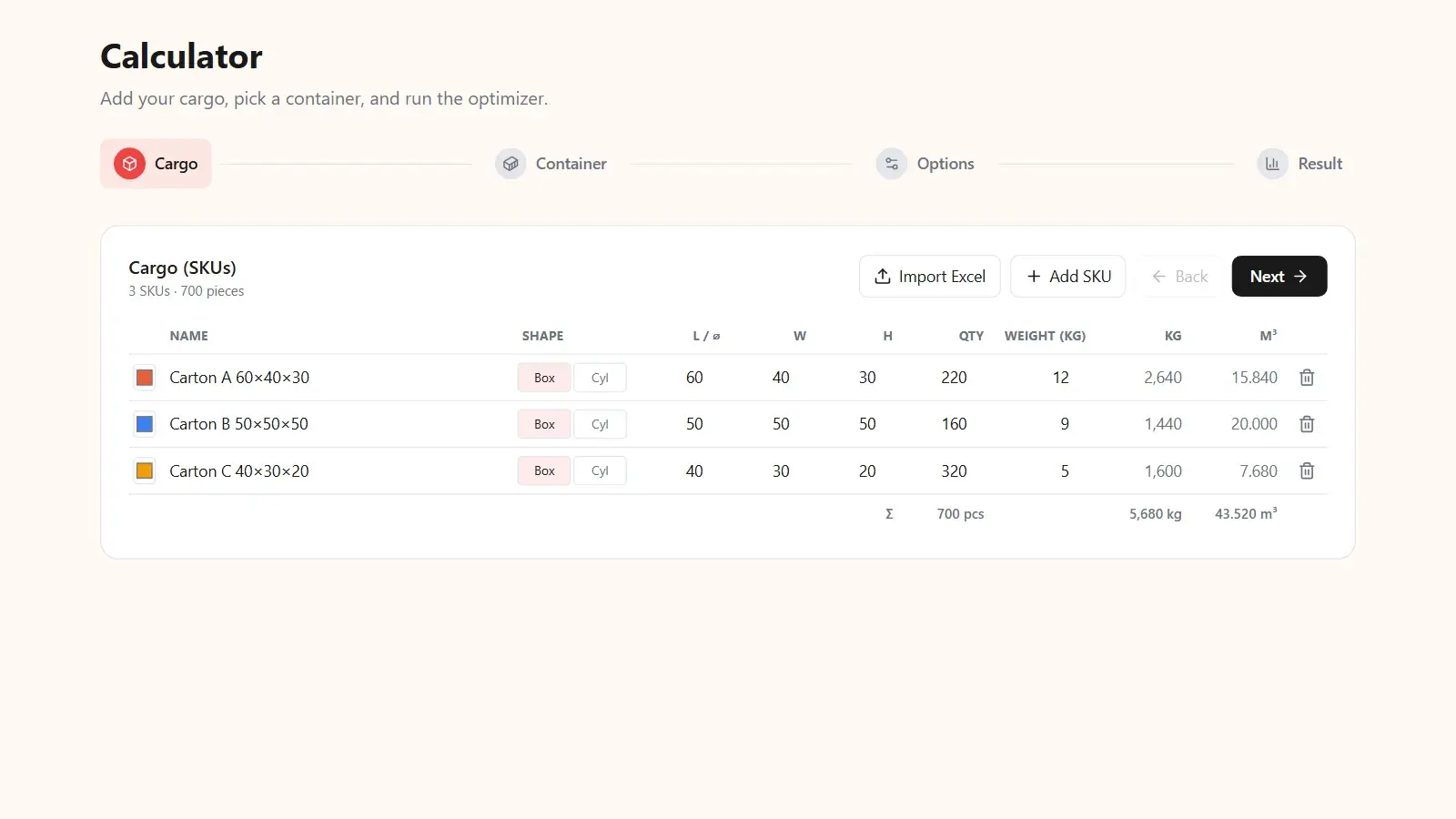
- Enter cartons (L×W×H in cm, kg, quantity) or cylinders, set per-item rotation and stacking rules, and choose a 20ft, 40ft or 40HC container, a custom size, or standard and custom pallets. Calculate returns in seconds.
- Each container in a multi-container plan shows units loaded, volume utilization and weight against the payload limit, so you see at once whether the second box is 5% or 50% full. Leftover units are reported honestly, never hidden behind a fake 100%.
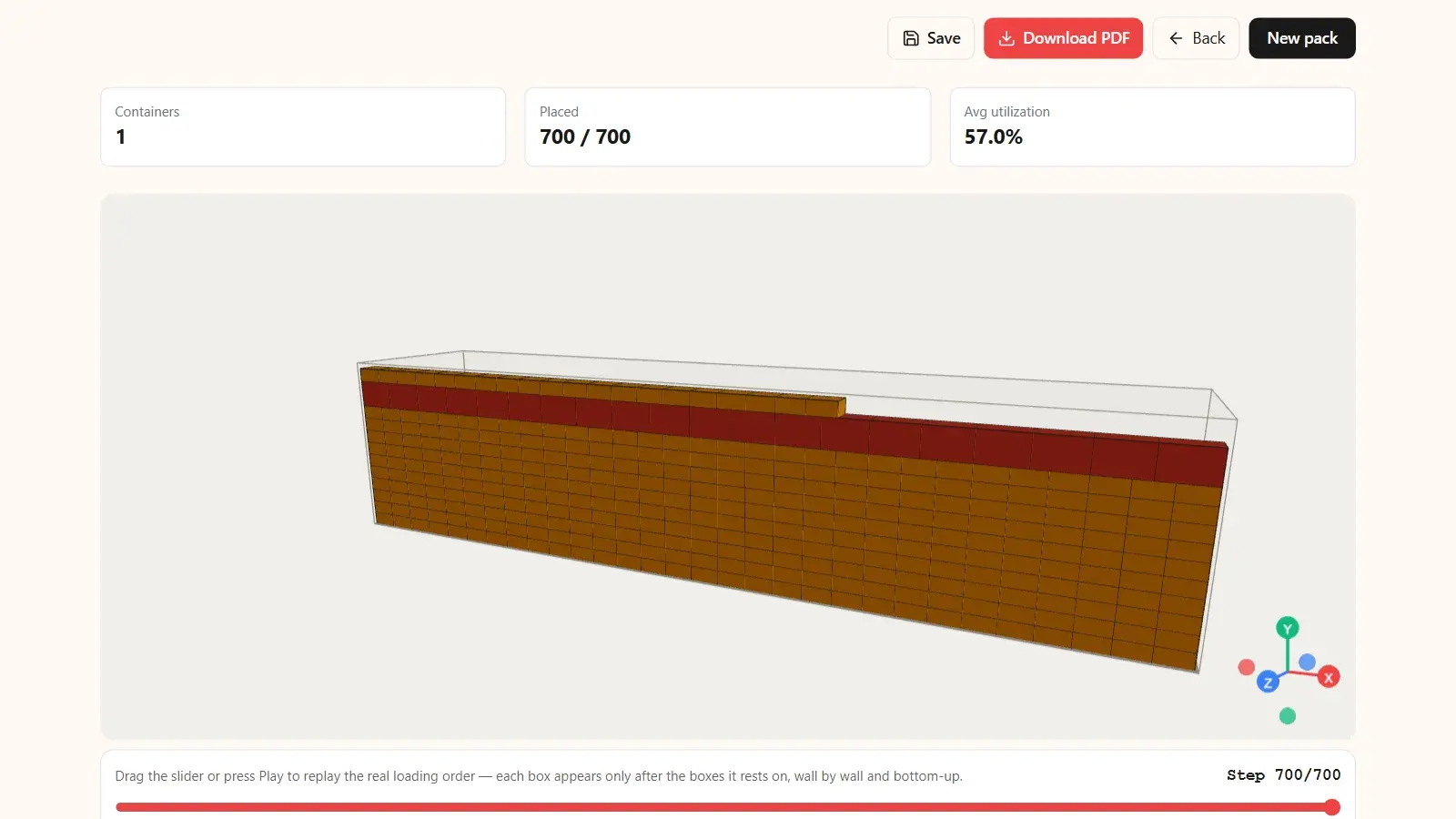
- Mixed SKUs are packed together in real 3D, every box has exact coordinates in the interactive view, and the engine never places a box past a container wall.
- Save each variant to your dashboard to reopen and compare, and download a PDF load plan with 3D views, counts, utilization and weight for the warehouse.
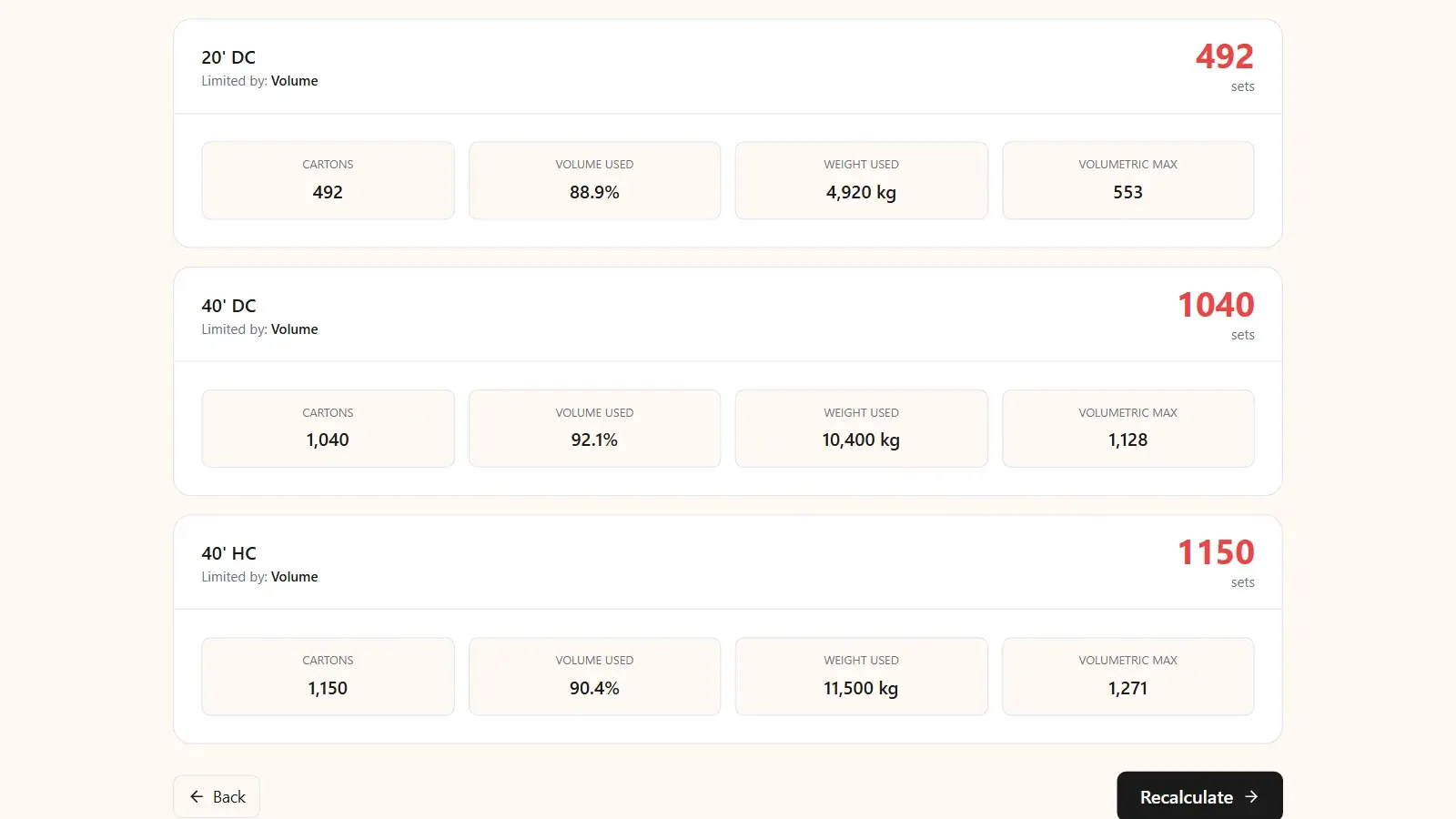
- For orders built from sets, the Capacity tool tells you how many complete sets fit per container and which limit binds.
Start in the calculator. On Pro, the same planning is available through the REST API and the MCP server for Claude, ChatGPT or Cursor (MCP docs).
Sources & method
- Engine data. Second-container fill: five single-SKU loads of 60×40×40 cm cartons (5 kg each), each sized to need a second 40 HC, Kubova engine, measured 2026-06-08. CBM-vs-achievable counts and fill by cargo profile come from the same measurement run. Container volumes (76.3, 67.7 and 33.2 m³) and payloads are typical catalogue values; crossover density = payload ÷ inner volume.
- Worked example. Illustrative; numbers invented to show the arithmetic.
- ISO 668:2020: classifies series 1 freight containers by external dimensions and ratings and gives minimum internal dimensions for some types; ISO 1496 is the authoritative document for internal dimensions. This is why interior figures here are typical, not guaranteed.
- Maersk dry container specifications (PDF): example carrier figures, such as a 40 ft high cube with 12,032 × 2,350 × 2,697 mm inside, 76 m³ and a 28,620 kg maximum payload, and a 20 ft standard with a 28,200 kg payload.
- Maersk: cargo weight limits: lists 28,690 kg and 76.4 m³ for a steel 40 ft high cube and notes that weight limits can vary by country, so figures differ between documents and boxes.
- Maersk: shipping dry cargo: dimensions vary with container series, and maximum payload includes dunnage and cargo-securing arrangements.
- IMO: SOLAS verified gross mass: amended SOLAS regulation VI/2, in force since 1 July 2016, makes the shipper responsible for providing the verified gross mass before loading.
- IMO: CTU Code: the non-mandatory IMO/ILO/UNECE code of practice on packing, loading and securing cargo in cargo transport units.