Kubova
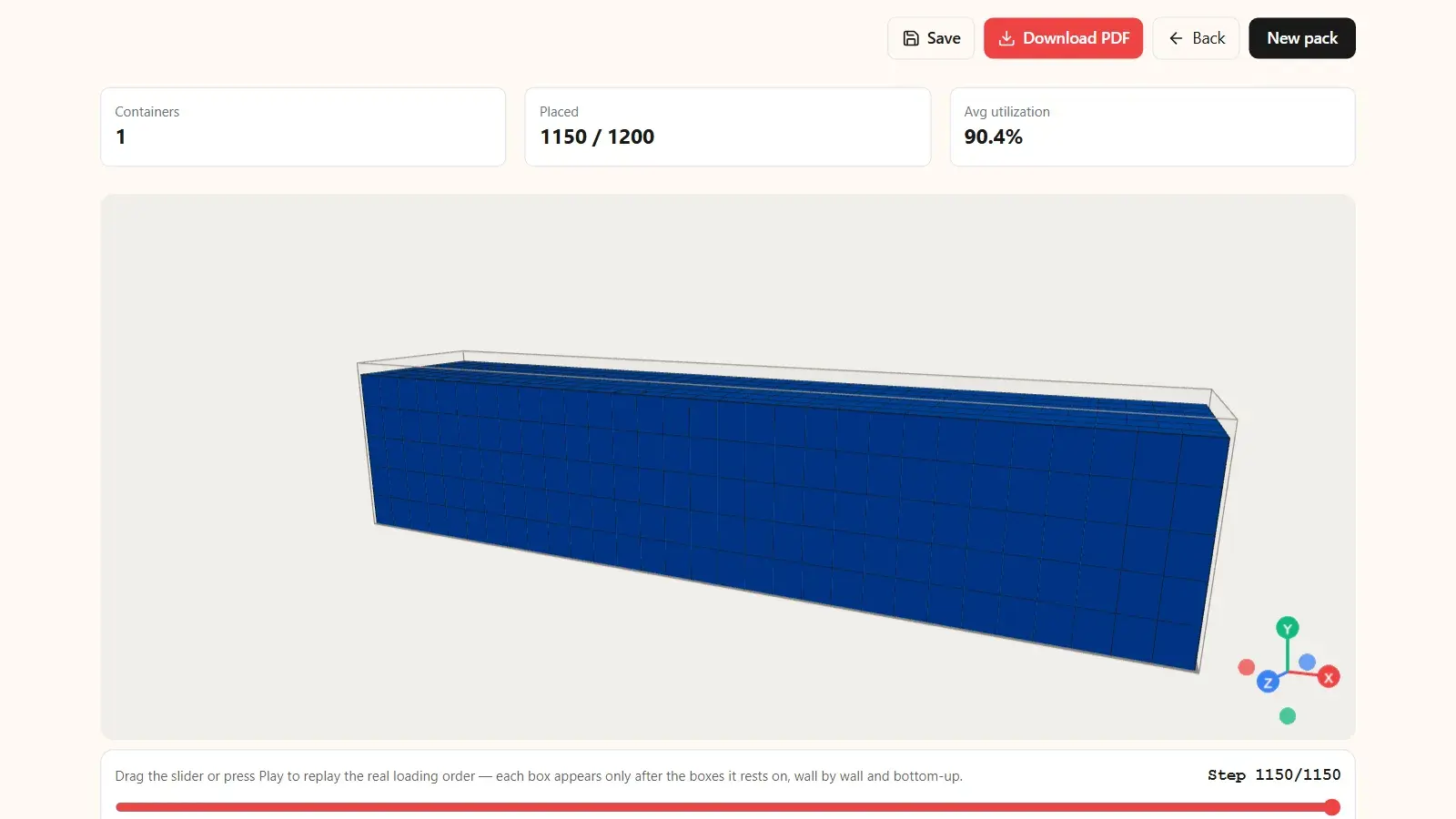
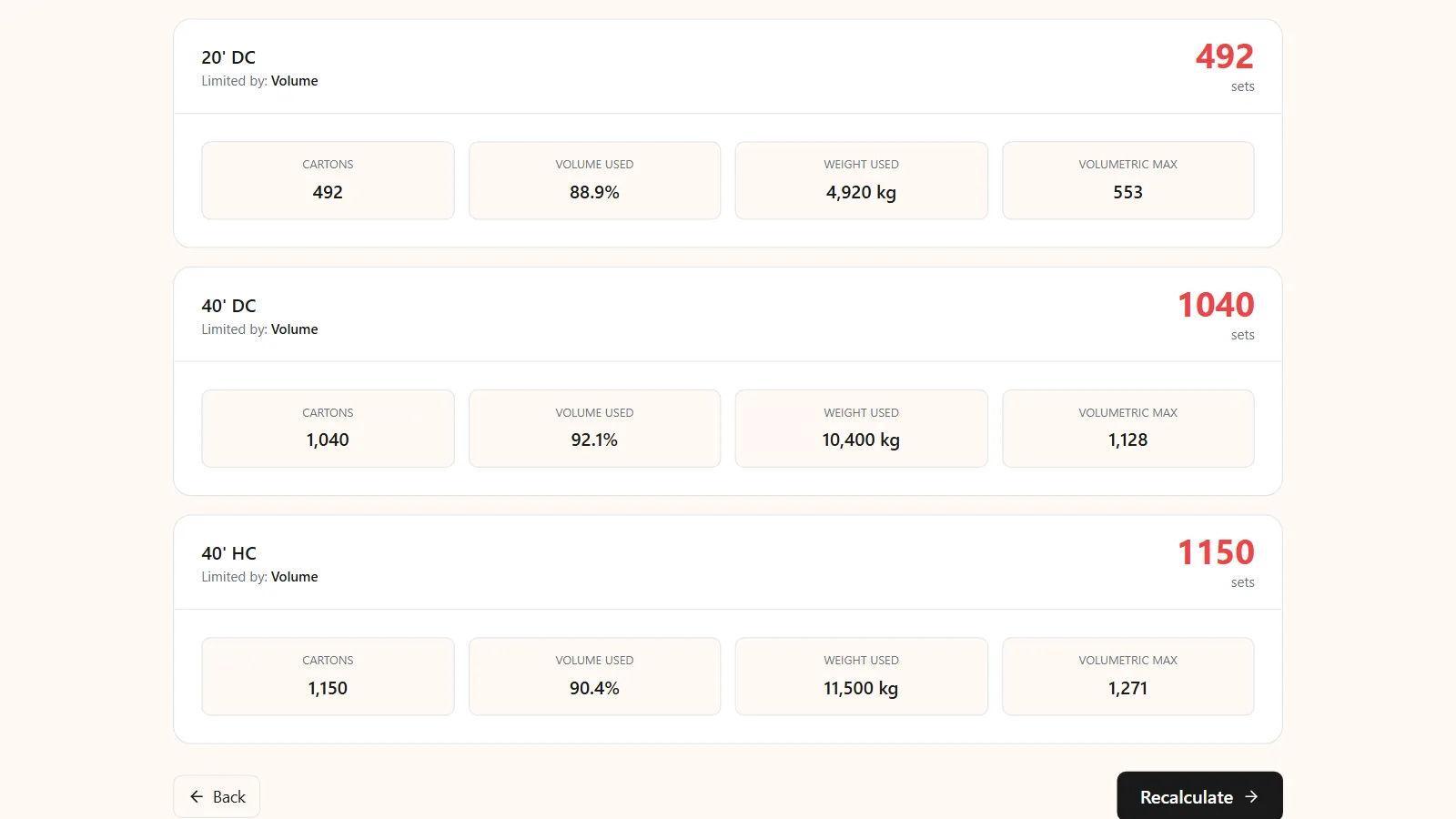
How many boxes fit in a 40ft container? Fewer than container volume ÷ carton volume, every time. A 40 HC has about 76.3 m³ inside. Across six common carton sizes, that formula overshot the real count by 12.8% on average and by 20.7% for a 30 cm cube. Engine-measured examples: about 1,150 cartons of 50×40×30 cm, 660 of 60×40×40 cm and 2,466 of 40×30×25 cm.
The volume formula is the number most people quote, and it errs in the expensive direction: it promises cartons that never make it into the box. Below are the measured counts, where the missing space actually goes, a by-hand method that gives you a safe lower bound, and the checks (weight, container height, carton bulge, door) that decide whether one container is enough.
Measured: how many cartons fit in a 40 HC
We packed six common carton sizes into a single 40 HC with our engine and compared the result with the volume formula. Every carton was allowed to rotate and weighed 1 kg, so weight never limited the load and the comparison isolates the space question.
| Carton (cm) | Volume formula | Actually fits | Volume used | Overestimate |
|---|---|---|---|---|
| 60 × 40 × 40 | 794 | 660 | 83.1% | 16.9% |
| 50 × 40 × 30 | 1,271 | 1,150 | 90.4% | 9.5% |
| 40 × 30 × 25 | 2,542 | 2,466 | 97.0% | 3.0% |
| 30 × 30 × 30 | 2,825 | 2,240 | 79.3% | 20.7% |
| 80 × 60 × 50 | 317 | 285 | 89.7% | 10.1% |
| 120 × 80 × 60 | 132 | 110 | 83.1% | 16.7% |
Single-SKU loads in one 40 HC, Kubova packing engine, measured 2026-06-08. 'Volume formula' = floor(container inner volume ÷ carton volume). 'Overestimate' = (formula − fits) ÷ formula.
12.8% — average overestimate of the volume formula
97.0% — best real fill (a well-proportioned carton)
79.3% — worst real fill (a 30 cm cube)
Two things stand out. The gap is never zero, even for the best carton. And size alone does not predict it: the 30 cm cube (0.027 m³) is smaller than the 40×30×25 cm carton (0.030 m³), yet it lost almost seven times as much of the formula count.
Why the volume formula overshoots
Because rotation was free and weight irrelevant in these runs, the entire gap is geometry, and geometry means remainders. The engine used Kubova's standard 40 HC: 1,203.5 cm long, 235.2 cm wide and 269.5 cm high inside.
Take the 30 cm cube. Along the length, 40 cubes fit with 3.5 cm left over. Across the width, 7 fit with 25.2 cm left. Up the height, 8 layers fit with 29.5 cm left. 40 × 7 × 8 = 2,240, exactly what the engine placed. The top gap is half a centimetre short of a ninth layer (9 × 30 = 270 cm), and turning a cube changes nothing, so that slab of air is permanent.
On top of pure geometry, real loads lose space to:
- Orientation rules. "This side up" marks remove the orientations that would have closed a gap. The CTU Code tells packers to observe such handling marks, so treat them as hard constraints. Our benchmark allowed every orientation; a load with locked orientations will usually fit fewer.
- Stacking limits. Fragile or crushable cartons that cannot carry weight on top leave the space above them empty.
- Weight. Dense cargo hits the payload limit with space still free (see the weight step below).
- Carton bulge. A carton that measures half a centimetre over its nominal size on each side can lose a whole row.
- The door, for pre-built units. In Kubova's catalogue the 40 HC door opening is 234 × 257.7 cm, while the inside is 269.5 cm high, so the opening is 11.8 cm lower than the roof. Loose cartons are loaded one at a time and are not affected, but a pallet stack or crate taller than the door opening cannot go in, even though it would fit inside.
The cube trap Cubes are among the worst shapes for fill. The 30 cm cube reached 79.3%, the lowest in our set, because it leaves a remainder on all three axes and no rotation can recover it. If you can influence carton design, proportion matters as much as raw size.
Illustrative example: the by-hand layer count
You can get a defensible lower bound with a pocket calculator. For each orientation the rules allow, divide each inner dimension by the matching carton side, round each result down, and multiply. Keep the best orientation.
Illustrative example (hand calculation, not engine output): a 50×40×30 cm carton in the 40 HC above.
| Carton sides along length × width × height (cm) | Rows × columns × layers | Cartons |
|---|---|---|
| 50 × 40 × 30 | 24 × 5 × 8 | 960 |
| 40 × 50 × 30 | 30 × 4 × 8 | 960 |
| 50 × 30 × 40 | 24 × 7 × 6 | 1,008 |
| 30 × 50 × 40 | 40 × 4 × 6 | 960 |
| 40 × 30 × 50 | 30 × 7 × 5 | 1,050 |
| 30 × 40 × 50 | 40 × 5 × 5 | 1,000 |
The best single orientation gives 1,050 cartons (63.0 m³, 82.6% fill). The engine fit 1,150 and the formula claims 1,271. The extra 100 come from using more than one orientation in the same load. For example, every single orientation leaves 25 to 35 cm of the 235.2 cm width unused, while three cartons placed 50 cm wide plus two placed 40 cm wide fill 230 cm of it.
The same ladder holds for all six cartons:
| Carton (cm) | Best single orientation (floor) | Engine 3D pack | Volume formula (ceiling) |
|---|---|---|---|
| 60 × 40 × 40 | 600 | 660 | 794 |
| 50 × 40 × 30 | 1,050 | 1,150 | 1,271 |
| 40 × 30 × 25 | 2,160 | 2,466 | 2,542 |
| 30 × 30 × 30 | 2,240 | 2,240 | 2,825 |
| 80 × 60 × 50 | 240 | 285 | 317 |
| 120 × 80 × 60 | 90 | 110 | 132 |
Floor column: hand calculation over all six orientations with the inner dimensions above (illustrative). Engine and formula columns: measured 2026-06-08.
On every rectangular carton the 3D pack beat the best single orientation, by 9.5% (50×40×30) up to 22.2% (120×80×60). On the cube the two tie, because a cube has only one orientation.
Standard 40ft or High Cube: what the extra height buys
All the numbers above are for a 40 HC. A standard 40ft (40 DC) has the same floor but, in Kubova's catalogue, 239.3 cm of inner height instead of 269.5 cm: 67.7 m³ against 76.3 m³, or 12.6% less volume. Whether you lose 12.6% of your cartons depends on how the carton height divides into those two numbers.
| Carton height, kept upright | Layers in 40 DC (239.3 cm) | Layers in 40 HC (269.5 cm) | Extra cartons in the HC |
|---|---|---|---|
| 25 cm | 9 | 10 | +11.1% |
| 30 cm | 7 | 8 | +14.3% |
| 40 cm | 5 | 6 | +20.0% |
| 50 cm | 4 | 5 | +25.0% |
| 60 cm | 3 | 4 | +33.3% |
Illustrative arithmetic: floor(inner height ÷ carton height), for cartons that must stay this way up. With free rotation the difference can be smaller.
Look at 30 cm and 60 cm: 239.3 cm is 0.7 cm short of 240 cm, so the standard box loses a whole layer to less than a centimetre. Inner heights differ between carriers and builds, which is why you should check the spec sheet of the box you are actually booking rather than a generic table. Payload barely changes between the two (28,800 kg for the 40 DC and 28,620 kg for the 40 HC in the catalogue), so the High Cube's extra space only pays on light cargo. For dense cargo a 20ft can be the better unit; see 20ft vs 40ft: which container to choose.
How to estimate boxes in a 40ft container, step by step
- Measure the real outer carton size in cm, including bulge, and the packed gross weight per carton.
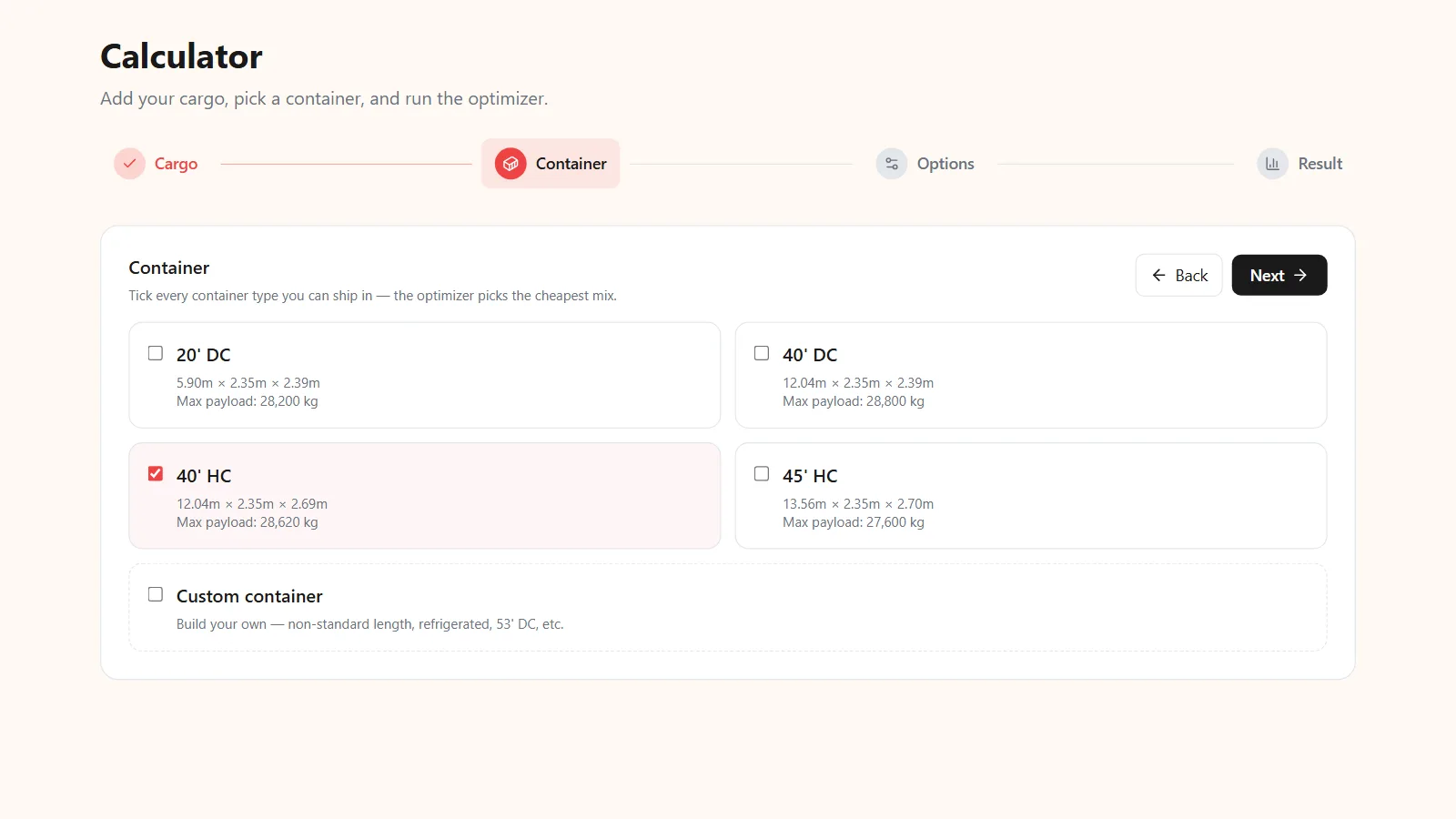
- Get the inner dimensions and payload of the box type you will book from the carrier's spec sheet. Typical 40 HC values are about 1,203.5 × 235.2 × 269.5 cm and about 28.6 t payload, but they vary.
- Compute the ceiling: floor(inner volume ÷ carton volume). Use it only as an upper bound, never as a quote.
- Compute the floor: the layer count above, for each allowed orientation. With "this side up", only the two orientations with the carton's height vertical are allowed.
- Expect the real 3D count between the two. In our six runs the achievable count was 79% to 97% of the formula, 87% on average.
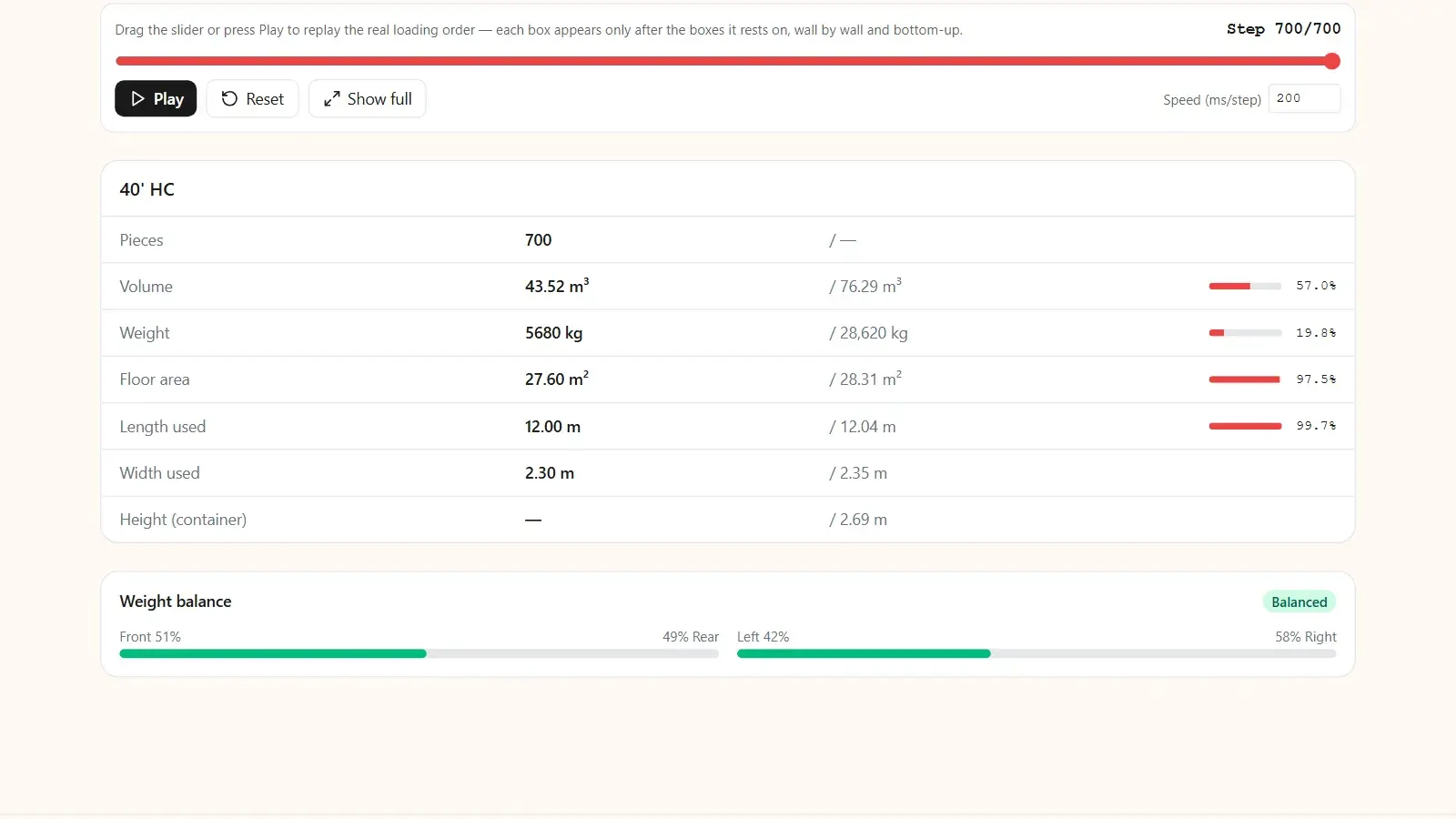
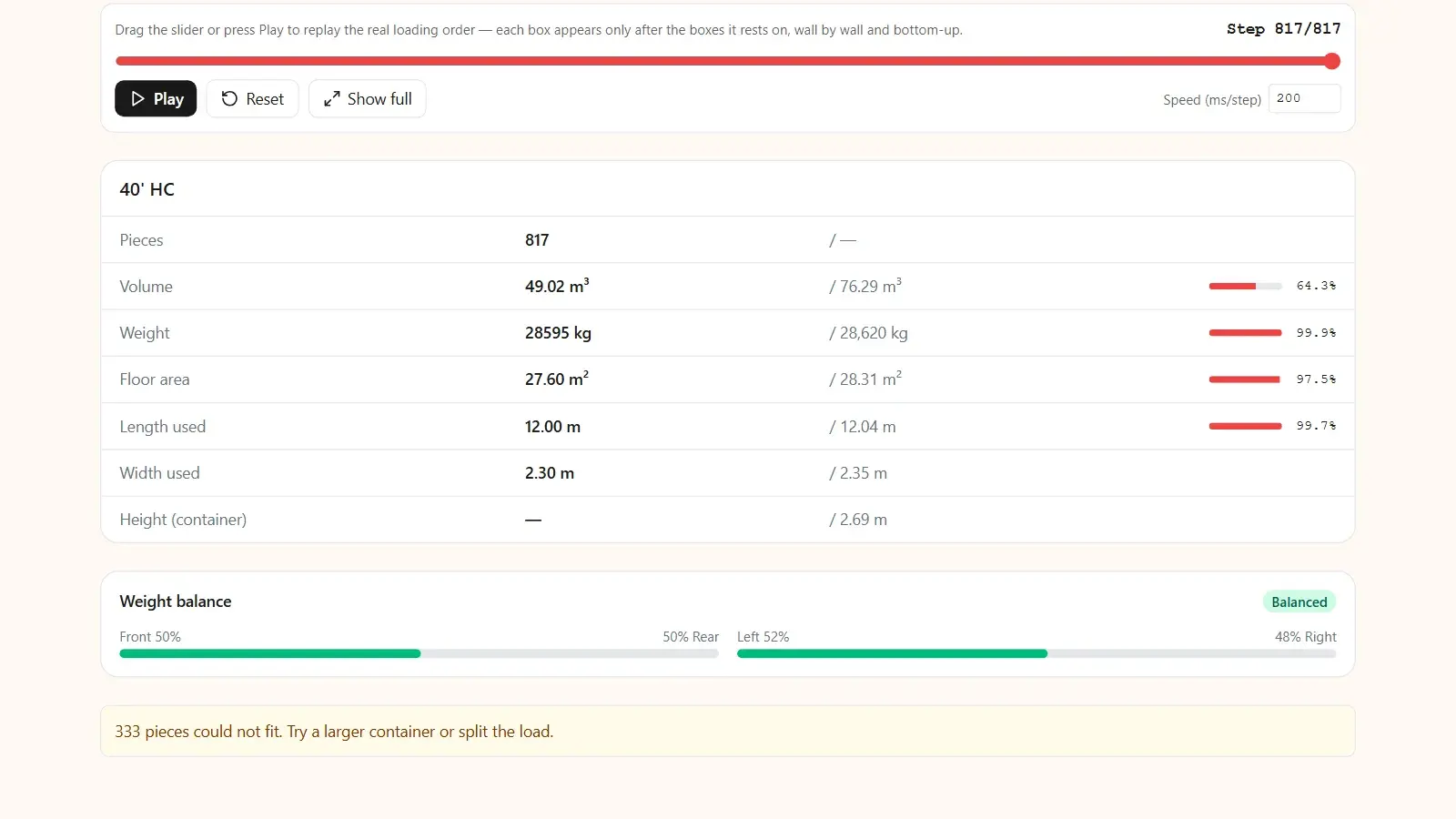
- Check weight: divide the payload by the count. For a 50×40×30 cm carton that is 28,620 kg ÷ 1,150 ≈ 24.9 kg. If your carton is heavier, the count is floor(payload ÷ carton weight) instead. The full method is in volume vs weight: which limit hits first.
- Check pallets and crates against the door and the floor: a stack taller than the door opening cannot be loaded, and pallet footprints tile the floor differently from loose cartons (see how many boxes fit on a pallet).
- When the number decides a booking (one container or two, which type, a price you quote) run a real 3D plan instead of a formula.
Common mistakes that inflate the count
- Quoting the formula. It is a ceiling no real load reaches; in our runs it was 3% to 21% too high.
- Using the outside dimensions. A 40 HC is 40 ft × 8 ft × 9 ft 6 in outside, about 86.1 m³, nearly 10 m³ more than the roughly 76.3 m³ inside.
- Using the nominal carton size. Illustrative: a carton that really measures 50.5 × 40.5 × 30.5 cm instead of 50 × 40 × 30 cm drops the best layer count in a 40 HC from 1,050 to 1,015.
- Assuming every 40ft is the same box. A standard 40ft and a High Cube differ by a full layer for most carton heights, and inner heights vary by carrier.
- Expecting 100%. No real carton load fills a container like a liquid; a plan that claims it is ignoring geometry or overflowing the walls.
How Kubova handles this
The measured counts in this article came from the same engine that runs the 3D container loading calculator. Enter each carton's length, width and height in cm, its weight and quantity, set per-item rotation and stacking rules (including "this side up"), and pick a 20ft, 40ft or 40 HC container or your own custom dimensions. Calculate returns in seconds.
The result is an interactive 3D view in which every box has exact coordinates, with units loaded, volume utilization and weight against the payload limit. The engine never places a box past a container wall to inflate a count, and if part of the order does not fit, the leftover units are reported plainly instead of being rounded into a 100% that you cannot load. Mixed SKUs are packed together, and orders that need more than one container come back as a multi-container plan. Save the pack to your dashboard, reopen it later, or download a PDF load plan with 3D views, counts, utilization and weight for the warehouse.
If you ship repeating sets, such as a table with four chairs in three cartons, the capacity tool tells you how many complete sets fit per container and which limit binds. If your cartons live in a spreadsheet or a supplier's PDF, an AI assistant connected to Kubova can read the packing list and run the calculation for you; see plan a container load from ChatGPT or Claude.
Sources & method
- Measured counts: Kubova packing engine, measured 2026-06-08. Single-SKU loads in one 40 HC from Kubova's standard catalogue (inner 1,203.5 × 235.2 × 269.5 cm, 76.3 m³), rotation and stacking allowed, 1 kg per carton so that only volume binds.
- Hand calculations: the single-orientation floors, the 40 DC layer comparison, the bulge example and the weight threshold are arithmetic on the same catalogue dimensions and payloads, labelled illustrative. They are not engine output.
- Container dimensions: ISO 668:2020 classifies series 1 freight containers by external dimensions and specifies their ratings and, for certain types, only minimum internal and door-opening dimensions; it names ISO 1496 as the authoritative document for internal dimensions, with ISO 1496-1:2013 covering general-purpose cargo containers. Inner dimensions and payloads in this article are typical catalogue values; real boxes vary by carrier and build, so confirm against your carrier's spec sheet.
- Packing practice: the IMO/ILO/UNECE CTU Code (full text: MSC.1/Circ.1497), chapter 3: do not exceed the permitted payload of the unit, and observe handling marks such as "this side up".