Kubova
Volume vs weight: divide your cargo's weight by its volume and compare the result with the container's crossover density. A 40 HC crosses at about 375 kg/m³, a 40 DC at about 425 and a 20 DC at about 850. Below the crossover you run out of space first; above it you run out of weight first, and a volume-only count over-promises. Because no real load fills 100% of the space, weight binds slightly later in practice.
Every container has two ceilings, space and weight, and your cargo always hits one of them first. Get this backwards and a volume calculator will happily promise a load you cannot legally ship. Below are the crossover densities computed from typical container specifications, why the real threshold sits a little higher than the simple ratio, an exact per-carton test, and the weight items that are easiest to forget.
The crossover density, per container
The crossover is the payload limit divided by the inner volume. Pack cargo denser than this and, even in a perfectly full container, weight would cap you before space does.
| Container | Inner volume | Payload limit | Crossover density |
|---|---|---|---|
| 20' DC | 33.2 m³ | 28,200 kg | ≈ 850 kg/m³ |
| 40' DC | 67.7 m³ | 28,800 kg | ≈ 425 kg/m³ |
| 40' HC | 76.3 m³ | 28,620 kg | ≈ 375 kg/m³ |
Crossover = payload ÷ inner volume, computed from Kubova's standard container catalogue. These are typical values; real inner dimensions and payloads vary by carrier and build, so check the box you are booking.
375 — 40 HC crossover (kg/m³)
425 — 40 DC crossover (kg/m³)
850 — 20 DC crossover (kg/m³)
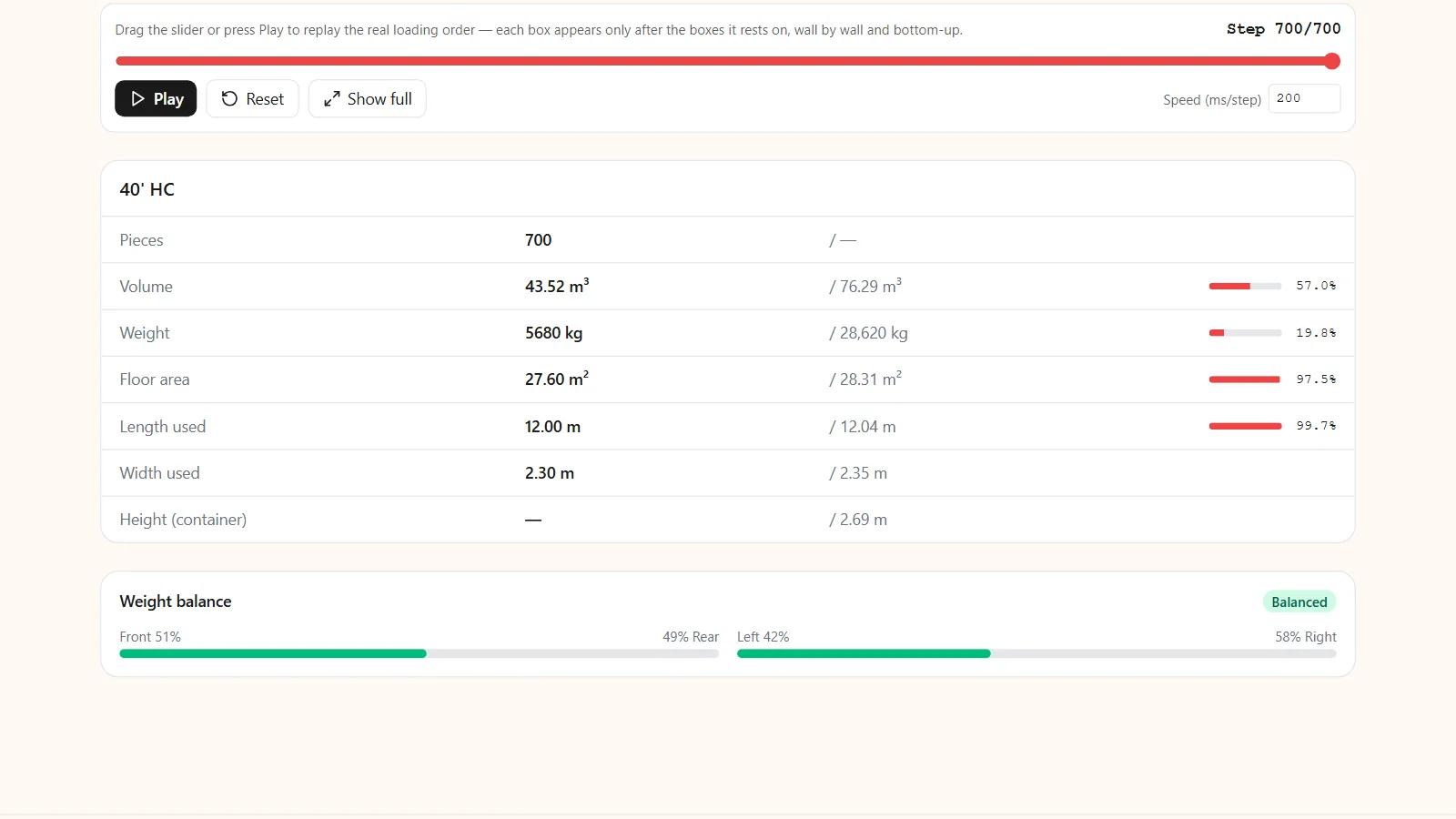
Why weight binds later than the table says
The simple crossover assumes your cargo fills 100% of the inner volume. It never does. In our engine benchmarks, light single-carton loads in a 40 HC used between 75.5% and 97.0% of the space (see container fill-rate benchmarks). Weight only takes over when the cargo you can actually load is heavier than the payload, so the real threshold is:
Weight binds when cargo density > payload ÷ (inner volume × the fill rate your cartons can reach).
| Container | At 100% fill | At 90% fill | At 80% fill |
|---|---|---|---|
| 40' HC | 375 kg/m³ | 417 kg/m³ | 469 kg/m³ |
| 40' DC | 425 kg/m³ | 472 kg/m³ | 531 kg/m³ |
| 20' DC | 850 kg/m³ | 944 kg/m³ | 1,062 kg/m³ |
Illustrative arithmetic: payload ÷ (inner volume × fill rate), using the catalogue values above.
In practice this means a grey zone. For a 40 HC, cargo below about 375 kg/m³ is always volume-limited and cargo above about 470 kg/m³ is weight-limited for any carton that fills 80% or more. In between, the answer depends on how well your particular carton packs, and the only reliable way to know is the per-carton test below.
Illustrative example: the per-carton test
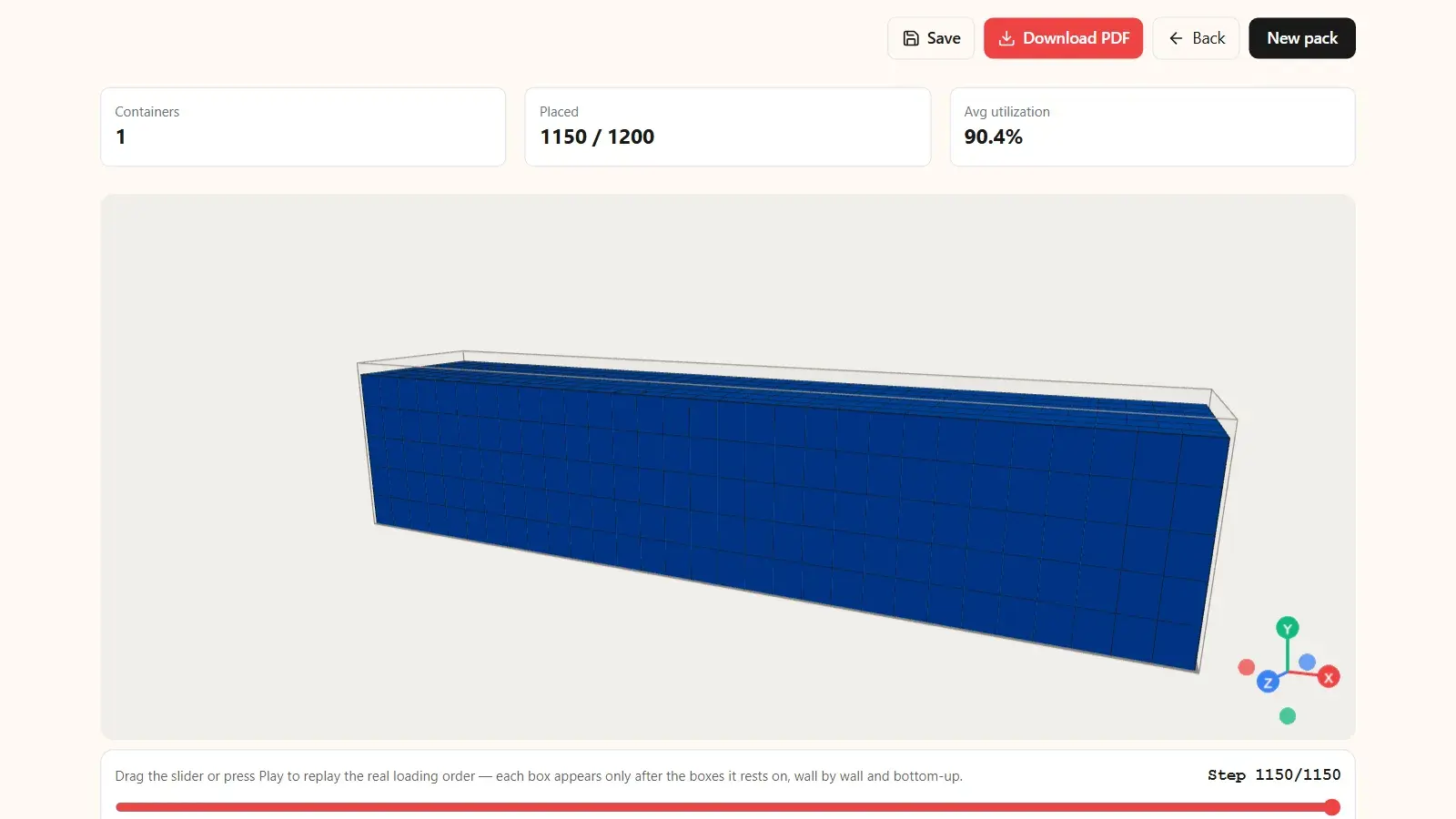
The exact test needs one measured number: how many of your cartons fit by volume. Our engine fit 1,150 cartons of 50×40×30 cm (0.06 m³ each) into a 40 HC (measured 2026-06-08). Divide the payload by that count:
28,620 kg ÷ 1,150 = 24.9 kg per carton, a density of about 415 kg/m³. Any carton lighter than that is volume-limited; any heavier carton is weight-limited, and the count becomes floor(payload ÷ carton weight).
| Carton weight | Density | Cartons loaded | Weight used | Volume used | Binding limit |
|---|---|---|---|---|---|
| 12 kg | 200 kg/m³ | 1,150 | 13,800 kg (48.2%) | 90.4% | Volume |
| 24 kg | 400 kg/m³ | 1,150 | 27,600 kg (96.4%) | 90.4% | Volume |
| 30 kg | 500 kg/m³ | 954 | 28,620 kg (100%) | 75.0% | Weight |
| 36 kg | 600 kg/m³ | 795 | 28,620 kg (100%) | 62.5% | Weight |
Illustrative arithmetic on the measured volume count of 1,150. The carton weights are examples, not measurements.
Look at the 24 kg row. At 400 kg/m³ this cargo is above the 375 kg/m³ table crossover, yet it is still volume-limited, because the carton only fills 90.4% of the space. Rely on the simple ratio and you would have planned it as weight-limited. At 30 kg, a quarter of the container is empty when the payload runs out, and that is the correct plan, not a poor one.
Which limit is yours? Step by step
- Weigh a packed carton. Use gross weight, including inner packaging, not the product's net weight.
- Measure its outer dimensions and compute its volume in m³.
- Compute density = weight ÷ volume. For a mixed shipment, use total kg ÷ total m³ as a first screen.
- Find the payload of the box you will actually get. The CTU Code notes that the maximum gross mass is on the container's CSC safety approval plate and that tare and payload are marked on the door end. The catalogue values above are typical, not guaranteed.
- Subtract everything that rides in the box but is not cargo. The CTU Code gives the cargo payload as maximum gross mass minus the container's tare, any attached equipment and the securing and bracing material. Pallets also count.
- Get the volume-limited count from a 3D plan or, as a floor, a layer count (method in how many boxes fit in a 40ft container).
- Run the per-carton test: payload ÷ count. If your carton is heavier, weight sets the count.
- Check the road and rail legs. The CTU Code tells packers not to exceed the maximum gross mass allowed by national road and rail regulations as well as the container's own limit, and those can be lower.
- Declare the verified gross mass. Since 1 July 2016, SOLAS has required the shipper to provide the verified gross mass of a packed container in time for the ship's stowage plan; without it the container is not loaded. It is obtained either by weighing the packed container or by weighing all packages, pallets, dunnage and securing material and adding the container's tare, using a certified method.
Rough density bands help with the first screen:
| Cargo example | Approx density | Limited by (40 HC) |
|---|---|---|
| Empty packaging, foam, apparel | ~50–150 kg/m³ | Volume |
| Mixed retail / furniture | ~150–350 kg/m³ | Volume |
| Books, dense electronics | ~350–500 kg/m³ | Grey zone: run the per-carton test |
| Tiles, stone, liquids, machinery | ~600+ kg/m³ | Weight |
Rough bands for orientation only; weigh and measure your own cartons.
Where CBM calculators go wrong A pure CBM (volume) calculator never looks at weight, so for dense cargo it returns a count you physically cannot load: the container would be over its payload while still looking half empty. For anything in or above the grey zone, check the count against the weight limit as well.
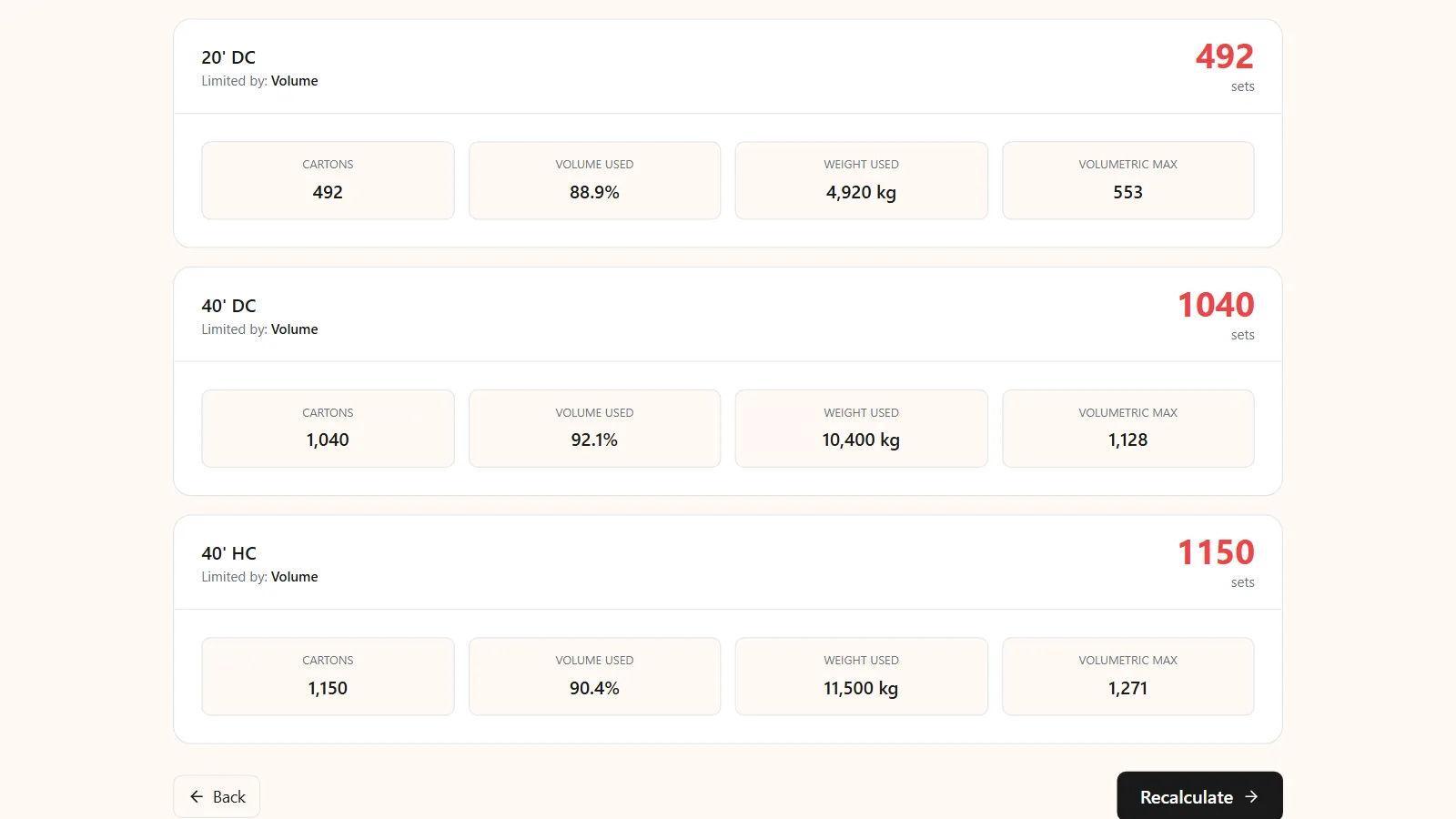
The counter-intuitive 20ft advantage
A 20 DC carries almost the same payload as a 40ft in about half the space of a 40 DC, so its crossover is far higher (about 850 kg/m³). That makes the humble 20 DC the right box for heavy, compact cargo: on dense goods a 40 HC reaches its weight limit with a large share of its space empty, and you pay to ship air.
The arithmetic also shows why two 20s can beat one 40. Two 20 DCs give 66.4 m³ and 56,400 kg of payload; one 40 DC gives 67.7 m³ and 28,800 kg. About the same space, almost twice the weight. Whether that is cheaper depends on your freight and trucking quotes. For a measured comparison of one dense carton in all three container types, see 20ft vs 40ft: which container to choose.
Common mistakes with container weight
- Using net product weight. Cartons, inner packs and fillers are part of the gross weight.
- Forgetting pallets and dunnage. Illustrative: 20 pallets at an assumed 25 kg each add 500 kg before any cargo is counted, plus whatever the bracing weighs.
- Treating the table crossover as a hard line. Cargo between about 375 and 470 kg/m³ in a 40 HC can go either way, as the 24 kg row shows.
- Assuming every box has the same payload. Payload depends on the individual container; read its markings or the carrier's spec for that equipment type.
- Loading the weight at one end. On weight-limited loads there is spare space, which makes uneven loading tempting. The CTU Code asks for the cargo's centre of gravity close to mid-length and mid-width, with a rule of thumb of no more than 60% of the cargo mass in 50% of the container's length, and warns against concentrating heavy cargo on small areas of the floor.
- Confusing chargeable weight with physical limits. Volumetric or chargeable weight is a pricing convention for some freight rates; it does not change what a container can physically carry. For a full container, the limits are inner volume and payload. See FCL vs LCL for how volume drives price on shared loads.
How Kubova handles this
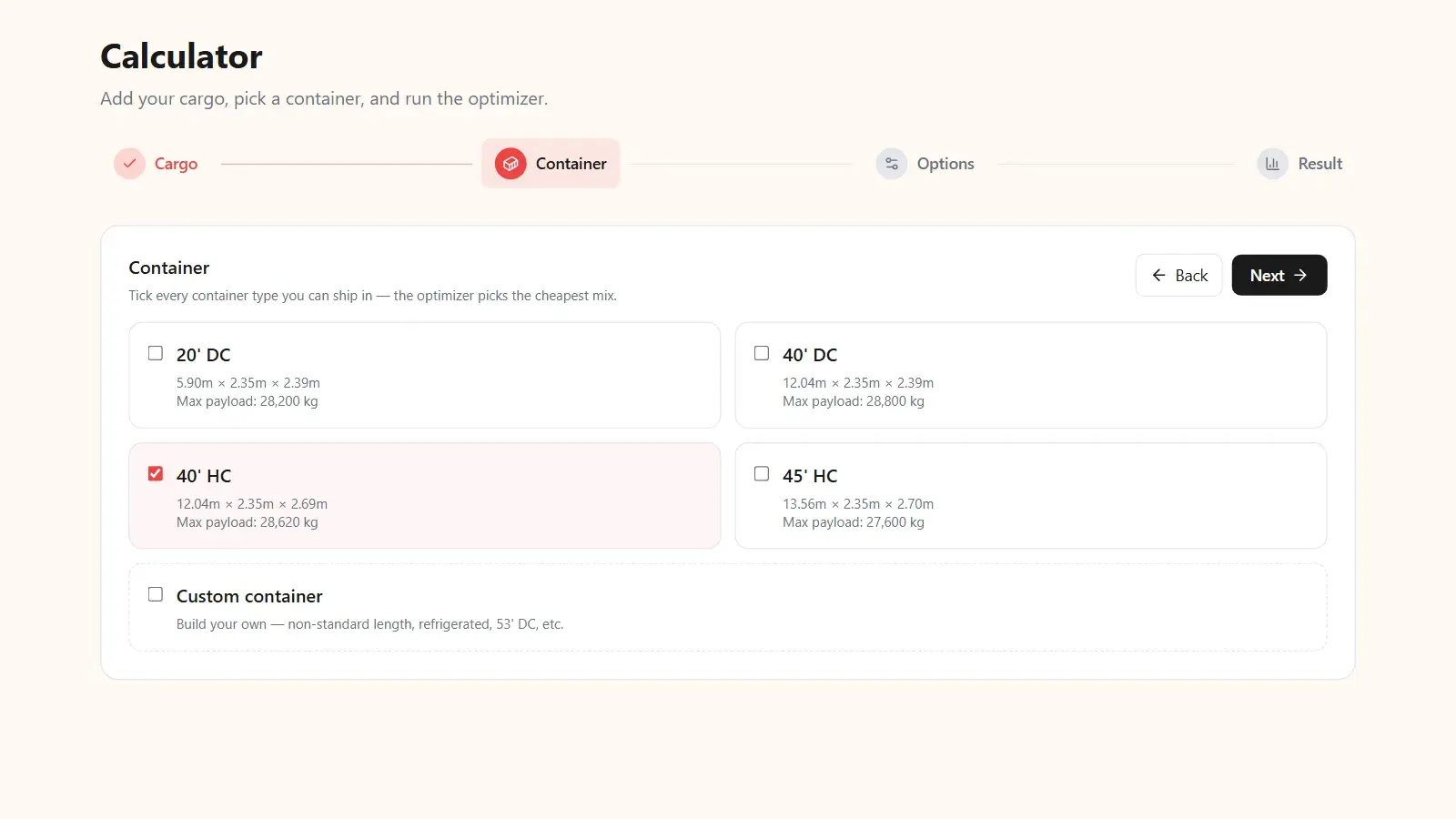
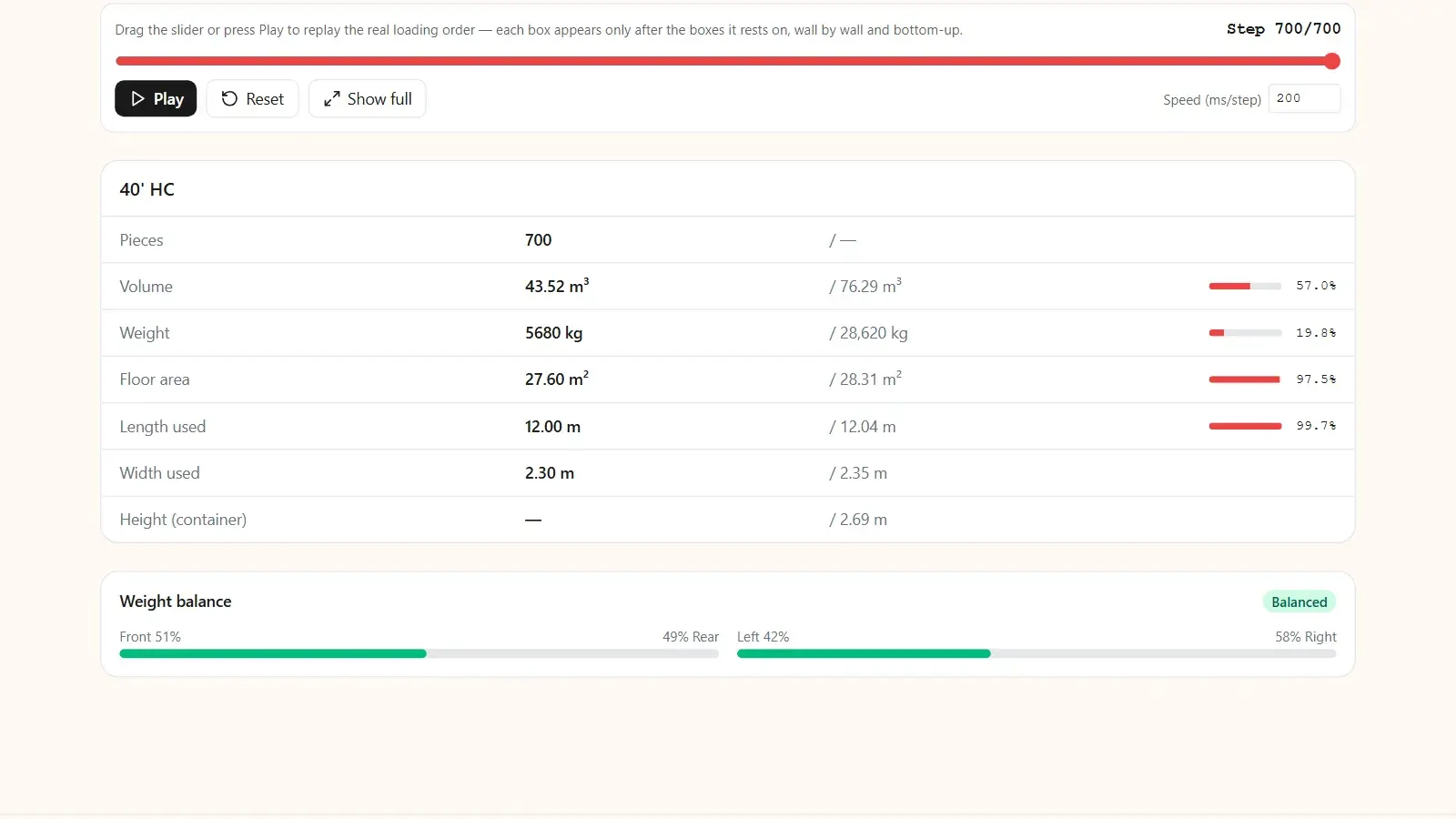
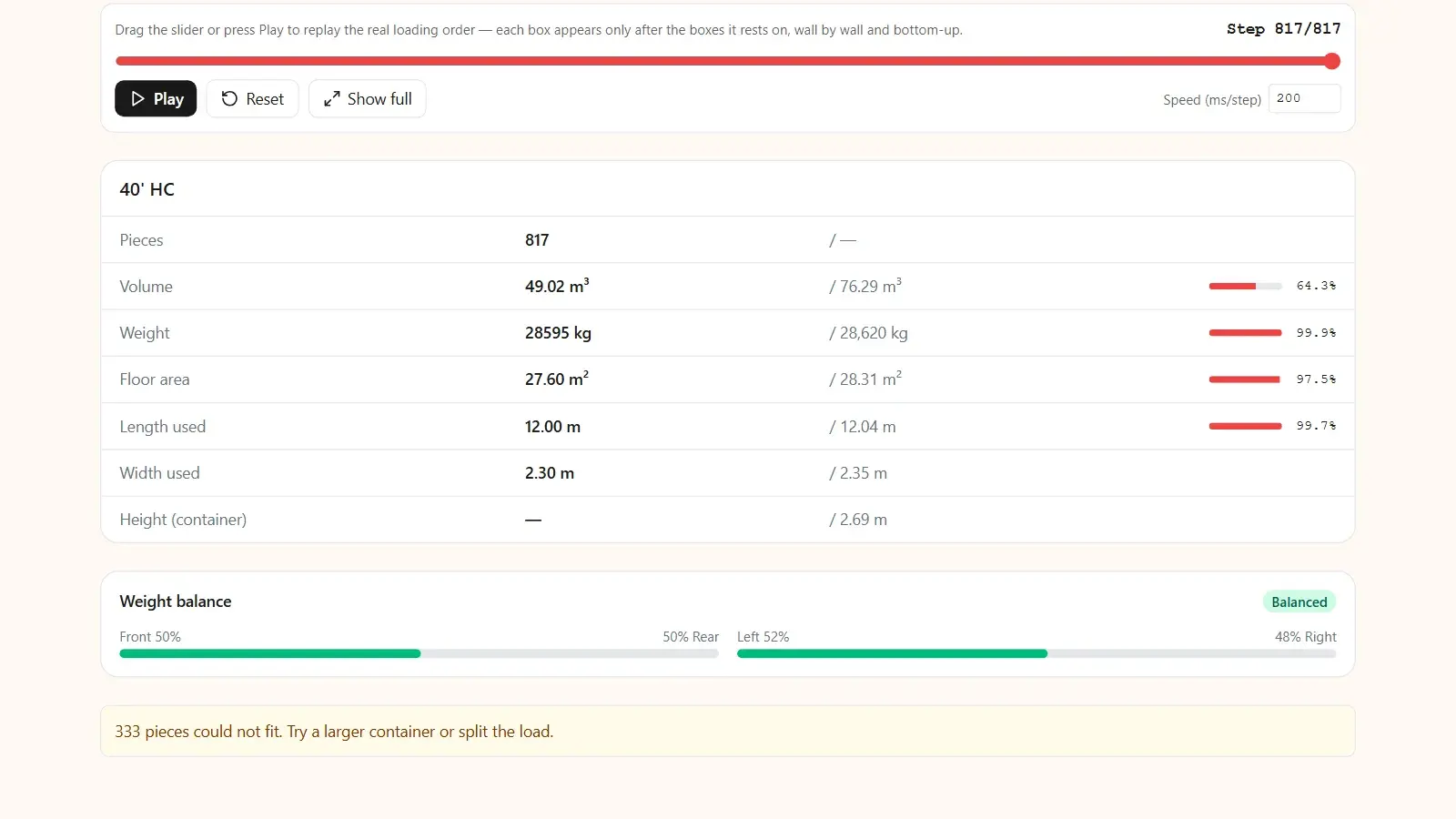
Kubova checks both ceilings in the same run. In the 3D container loading calculator you enter each carton's dimensions, weight and quantity, choose a 20ft, 40ft or 40 HC container or custom dimensions, and Calculate returns in seconds with volume utilization and weight against the payload limit for every container. When the payload stops the load before the space is full, the units that did not fit are reported as leftovers rather than squeezed in, and the engine never places a box past a container wall.
For palletised loads, choose a standard or custom pallet; the pallets' own weight is counted toward the container payload. Orders that need more than one container come back as a multi-container plan, and the PDF load plan records counts, utilization and weight for the warehouse. A planned weight is not a verified gross mass, though: the VGM must still come from one of the two approved weighing methods.
If you ship repeating sets, the capacity tool reports how many complete sets fit per container and whether volume or weight is the binding limit, which is exactly the question in this article. The same pack, capacity and report functions are available through the REST API and the MCP server (MCP docs).
Sources & method
- Crossover densities: payload ÷ inner volume, computed from Kubova's standard catalogue: 20 DC 589.8 × 235.2 × 239.3 cm (33.2 m³, 28,200 kg), 40 DC 1,203.5 × 235.2 × 239.3 cm (67.7 m³, 28,800 kg), 40 HC 1,203.5 × 235.2 × 269.5 cm (76.3 m³, 28,620 kg). These are typical values, not standards; confirm against your carrier's spec sheet. ISO 668:2020 sets external dimensions and ratings for series 1 freight containers and only minimum internal dimensions for certain types.
- Measured numbers: the 1,150-carton volume count and the 75.5% to 97.0% fill range are Kubova packing engine outputs, measured 2026-06-08 in a 40 HC with 1 kg cartons and rotation allowed.
- Illustrative numbers: the fill-adjusted crossovers, the per-carton weight table, the two-20ft comparison and the pallet example are arithmetic, labelled illustrative, not engine output.
- Payload, load distribution and road limits: IMO/ILO/UNECE CTU Code, full text MSC.1/Circ.1497: chapter 3 (do not exceed payload or road and rail gross-mass limits; distribute heavy cargo), section 6.2.2 (CSC plate and payload markings), annex 4 section 2.4 (payload = maximum gross mass − tare − attached items − securing material) and annex 7 section 3.1.4 (centre of gravity, 60% of mass within 50% of length).
- Verified gross mass: IMO, Verification of the gross mass of a packed container (SOLAS regulation VI/2, in force 1 July 2016; shipper responsibility and the two permitted methods).