Kubova
How many boxes fit on a pallet: it depends as much on the pallet as on the carton. For a 40×30×25 cm carton in a 2 m stack, our engine fit 64 on a EUR 120×80 pallet, 80 on a US 48×40, 80 on a 120×100 EPAL 3 and 51 on an EPAL CP5, up to 57% more on the best base. Yet the pallet holding the most boxes does not always fill a container best.
"How many boxes fit on a pallet?" sounds like a single number, but the same carton swings by more than half depending on the base, and the best base for a pallet is not always the best base for a container. Below: engine-measured counts, the layer arithmetic behind them, the height and weight limits that cap a stack, a worked container example, and a step-by-step method for your own cartons.
Same carton, four pallets
We packed a 40×30×25 cm carton (5 kg) onto four standard pallet templates, each with a 2 m cargo stack measured from the pallet deck. The box counts are direct engine outputs. The last column is our arithmetic: the share of the stack envelope (footprint × 2 m) that the cartons fill.
| Pallet | Footprint (cm) | Boxes (40×30×25) | Stack envelope filled |
|---|---|---|---|
| US Pallet 48×40 in | 121.9 × 101.6 | 80 | 96.9% |
| EPAL 3 (120×100) | 120 × 100 | 80 | 100.0% |
| EUR / EPAL 1 (120×80) | 120 × 80 | 64 | 100.0% |
| EPAL CP5 | 114 × 76 | 51 | 88.3% |
Single carton 40×30×25 cm, 5 kg, 2 m cargo stack, Kubova engine, measured 2026-06-08. Envelope filled = boxes × 30,000 cm³ ÷ (footprint × 200 cm).
Two things stand out. The best base held 57% more boxes than the smallest (80 against 51). And the EUR pallet, with 16 fewer boxes than the EPAL 3, fills its envelope just as completely: it is simply smaller. Per square metre of footprint, the EUR pallet and EPAL 3 both carry 66.7 boxes, the US pallet 64.6 and the CP5 58.9. Boxes per pallet measures pallet size as much as packing quality.
The formula: boxes per layer × layers
Boxes per pallet = boxes per layer × number of layers, then capped by the pallet's rated load. The stack height is the same here, so the difference comes from how the carton tiles each base:
- EUR 120×80. The 40×30 face tiles exactly: 4 cartons along the 120 cm side (4 × 30) and 2 along the 80 cm side (2 × 40) make 8 per layer. A 2 m stack holds 200 ÷ 25 = 8 layers, and 8 × 8 = 64, the engine's count with nothing wasted.
- EPAL 3 120×100 and US 48×40. No single orientation fills the 100 cm side, but two bands do: a 60 cm band of 3 × 2 cartons (40 cm along the length, 30 across) plus a 40 cm band of 4 cartons turned the other way (30 along, 40 across). That is 10 per layer on 120 × 100 cm, and 8 layers make 80. The US pallet's extra 1.9 × 1.6 cm is too small to use, which is why its envelope fill is 96.9%.
- CP5 114×76. The 40×30 face does not tile this base. By floor area a flat layer could hold at most 7 (8,664 ÷ 1,200 = 7.2), and a single-orientation grid holds only 4 (2 × 2). The engine's 51 is not a whole number of identical layers, so simple layer arithmetic cannot predict it; this is where a real 3D planner earns its keep.
Palletizing always trades some space for handling speed: the deck and the head-room above the stack are space a floor-loaded container would use. For the floor-loaded view of the same carton in a 40 HC, see how many boxes fit in a 40ft container.
Height and weight cap the stack
The counts above are volume-bound: 64 cartons × 5 kg is only 320 kg. Real cargo meets three other limits.
- Overall height. EPAL lists the Euro pallet and the EPAL 3 at 144 mm high and the CP5 at 138 mm, so a pallet with 2 m of cargo stands about 2.14 m overall. That clears the 2,274 mm door height Maersk lists for its standard 20 ft and 40 ft dry containers, but leave room for the forklift to lift it.
- Pallet rating. EPAL rates both the Euro pallet and the EPAL 3 at a 1,500 kg safe working load. Above 23.4 kg per carton (1,500 ÷ 64), the Euro pallet's rating caps you before the 2 m height does; for 80 cartons on an EPAL 3, the threshold is 18.75 kg (1,500 ÷ 80). If you stack loaded pallets on a solid, even floor, EPAL limits the load on the bottom pallet to 5,500 kg for the Euro pallet and 4,500 kg for the EPAL 3.
- Carton strength. In a column-stacked pallet, each bottom carton carries every carton above it. Eight layers of 5 kg cartons put 35 kg on it (7 × 5 kg); eight layers of 20 kg cartons put 140 kg on it. Don't plan a stack your cartons cannot carry.
Worked example: the pallet that loses per pallet can win per container
Illustrative example: our arithmetic on paper, not an engine run. Take the measured per-pallet counts and load one tier of pallets into a 20 ft dry container with a typical interior of about 5.90 × 2.35 m (Maersk lists 5,896 × 2,350 mm; check your box).
| Pallet | Boxes per pallet | Pallets on a 20 ft floor | Boxes per 20 ft |
|---|---|---|---|
| EUR 120×80 | 64 | 11 | 704 |
| EPAL 3 120×100 | 80 | 9 | 720 |
| US 48×40 | 80 | 9 | 720 |
| CP5 114×76 | 51 | 15 | 765 |
How the floor counts work:
- EUR: two pallets with the 120 cm side across need 2.40 m, and so do three with the 80 cm side across, both wider than 2.35 m. So one row of 7 turned crosswise (7 × 0.80 = 5.60 m long) runs beside a row of 4 lengthwise (4 × 1.20 = 4.80 m): 2.00 m wide, 11 pallets.
- 120×100 and 48×40: a row of 5 with the long side across (5 × 1.00 = 5.00 m; 5.08 m for 48×40) beside a row of 4 turned the other way (4 × 1.20 = 4.80 m; 4.88 m): 9 pallets, 2.20 to 2.24 m wide.
- CP5: three abreast with the 76 cm side across (3 × 0.76 = 2.28 m wide) in 5 rows of 1.14 m (5.70 m long): 15 pallets.
So the CP5, which held the fewest boxes per pallet, carries the most per 20 ft container: 765 against 704 for the EUR pallet, 8.7% more. Put another way, an order of 720 cartons fits a 20 ft as 9 EPAL 3 pallets or 15 CP5s, but on EUR pallets it needs 12 pallets (720 ÷ 64 = 11.25) where only 11 fit. The twelfth has no floor position, so 16 cartons travel loose, go LCL or miss the box (see when you can avoid a second container).
These are geometric upper bounds with no loading clearance; the CP5 row of three leaves only 7 cm of width play. Confirm them in a real plan, and repeat the check for your own container, because a different floor can reorder the pallets.
How to work out boxes per pallet for your carton
- Measure the carton as shipped: outer length, width and height in cm, including any bulge, and its gross weight.
- Set the footprint and the stack limit: the pallet's length × width, and the maximum cargo height you can accept (racking, truck, container door or customer specification). Measure cargo height from the deck, and add the deck when checking door clearance.
- Count boxes per layer in both flat orientations, then try mixed bands as in the 120×100 case. Keep overhang at zero unless your customer accepts it.
- Count layers: stack limit ÷ carton height, rounded down. If the carton may be turned on its side, test those heights too.
- Multiply, then cap by weight: boxes × carton weight must stay within the pallet's rated load, and the bottom carton must carry the stack above it.
- Check the container, not just the pallet: count how many pallets fit the floor in whole rows and multiply. That number decides how many containers you book.
- Check the rules for wood: raw-wood pallets crossing borders fall under ISPM 15, so confirm they are treated and marked.
Common mistakes
- Comparing boxes per pallet across different pallet sizes. A bigger base always looks better. Compare boxes per container, or per square metre of floor.
- Forgetting the deck. A "2 m pallet" stands about 2.14 m tall on an EPAL base. That is the figure to check against a door or a rack beam.
- Letting overhang inflate the count. Overhanging cartons get crushed by straps and neighbouring pallets, and they break the floor pattern in the container.
- Ignoring ISPM 15. ISPM 15, the IPPC standard for regulating wood packaging material in international trade, covers raw-wood packaging such as pallets, crates and dunnage. Its mark may only be applied to wood packaging treated in line with the standard, and EPAL says every newly produced EPAL pallet has been heat-treated to ISPM 15 since 1 January 2010. Wood packaging made wholly of processed wood, such as plywood, falls outside its scope. Check your destination's import rules before shipping on unmarked wood.
- Using one pallet for every lane. The best base depends on the carton and the container, and the 20 ft example shows the ranking can flip. Mixed orders add another layer of choice; see mixed-SKU container loading.
How Kubova handles this
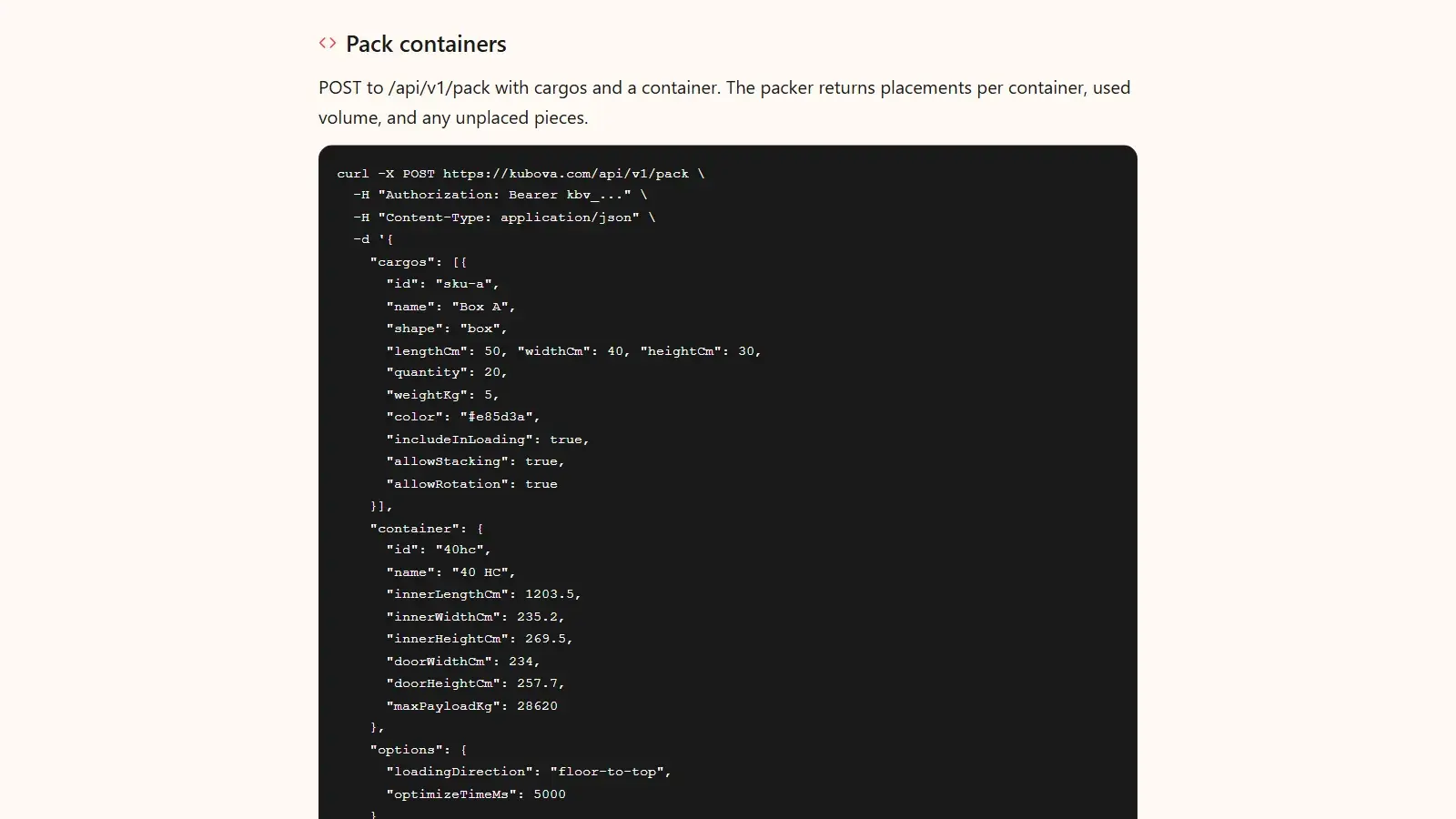
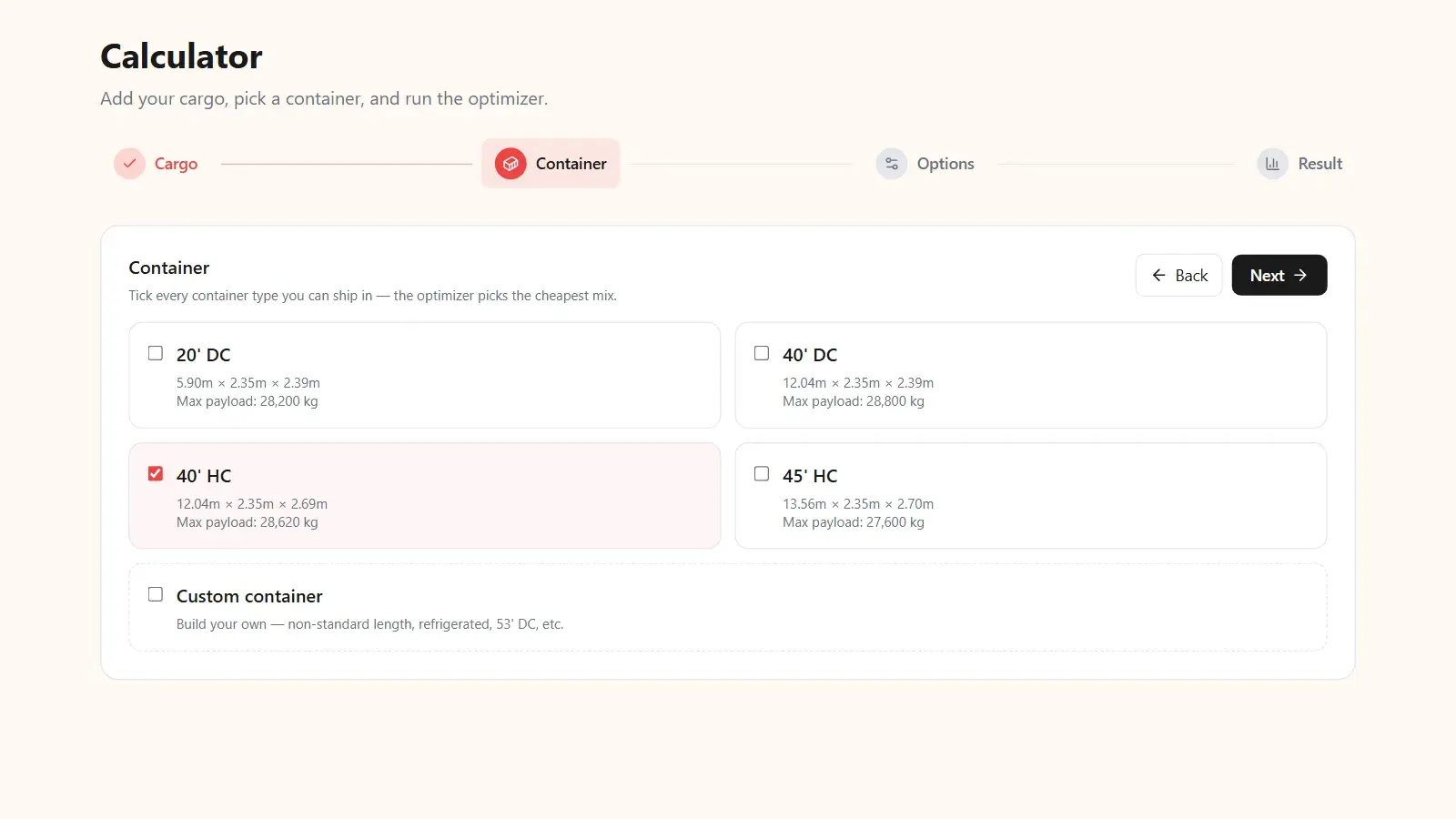
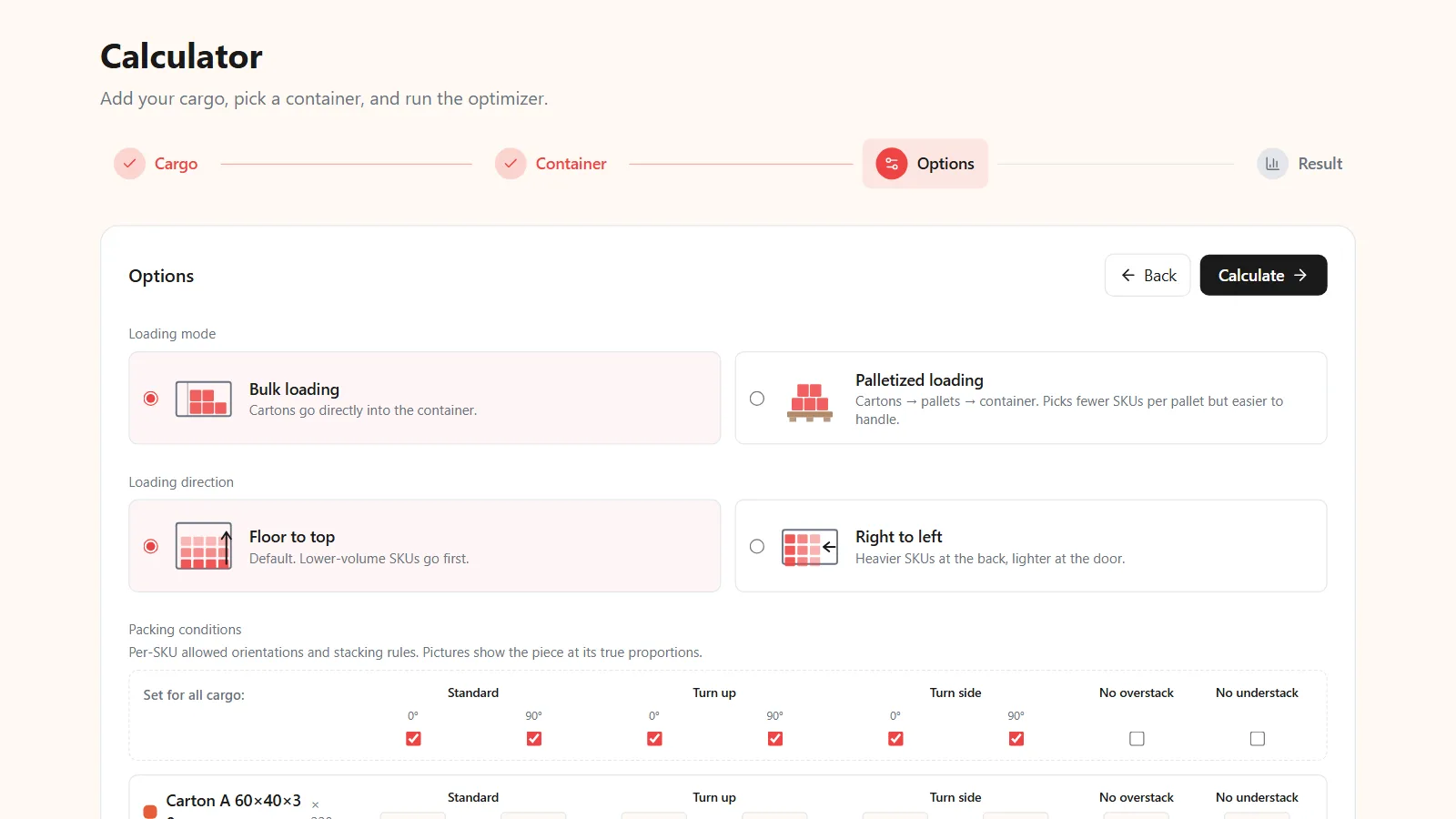
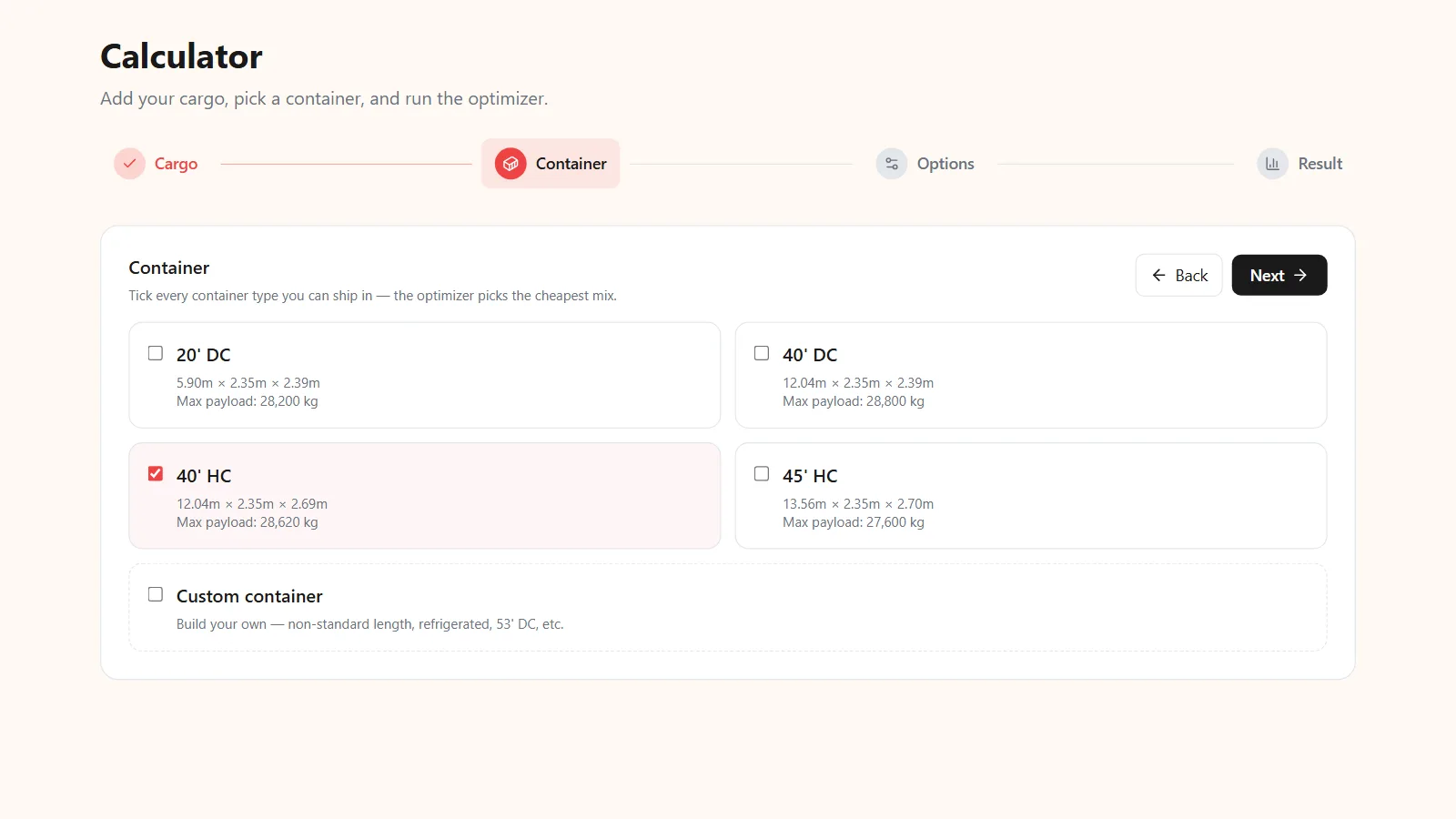
- Enter cartons (L×W×H in cm, kg, quantity) with per-item rotation and stacking rules, then pick a standard pallet (templates include EUR / EPAL 1, EPAL 3, CP5 and US 48×40) or define a custom one, and choose a 20ft, 40ft, 40HC or custom container.
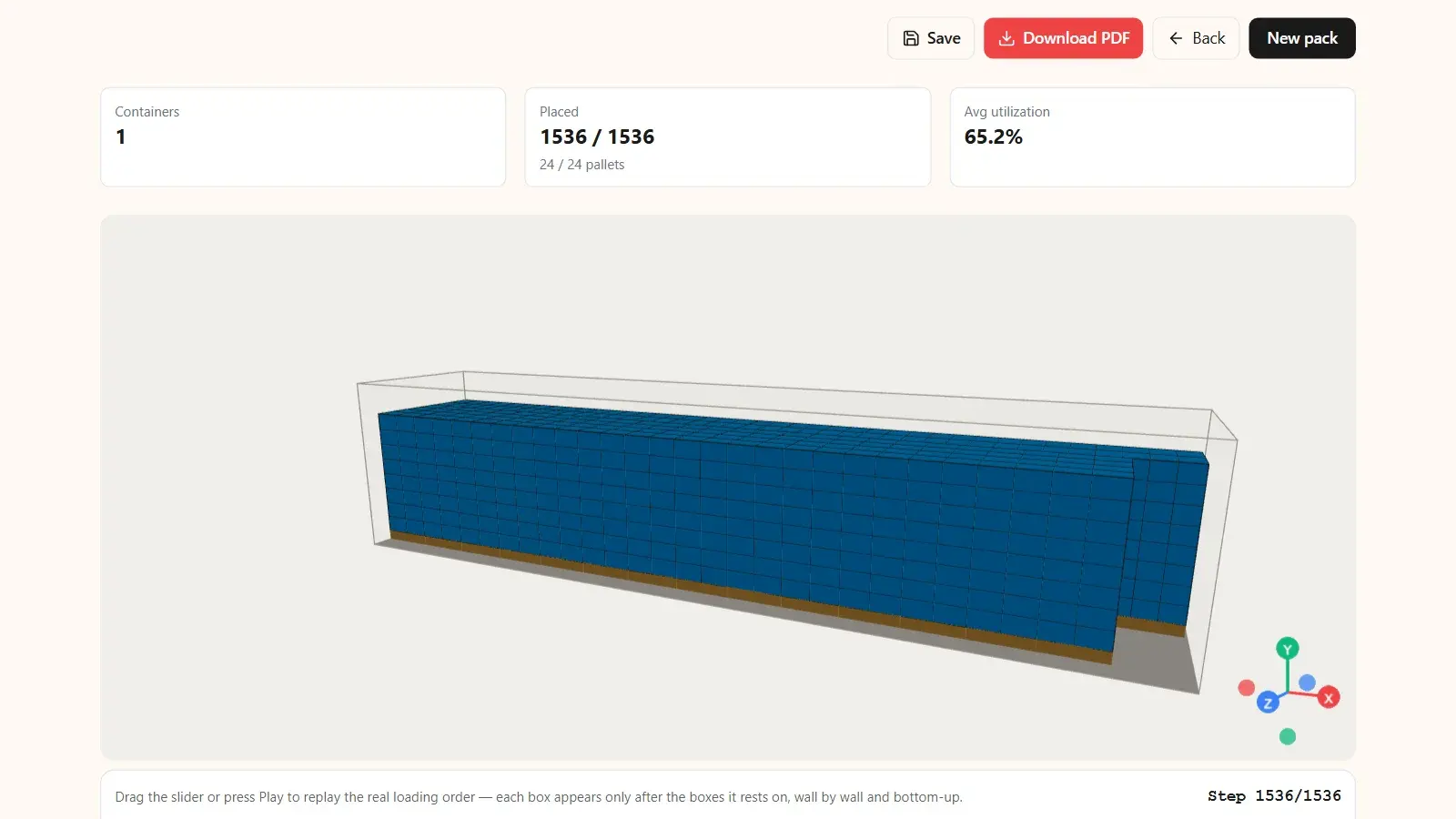
- Kubova packs cartons onto pallets and pallets into the container in real 3D, and Calculate returns in seconds. The engine never places a box past a container wall.
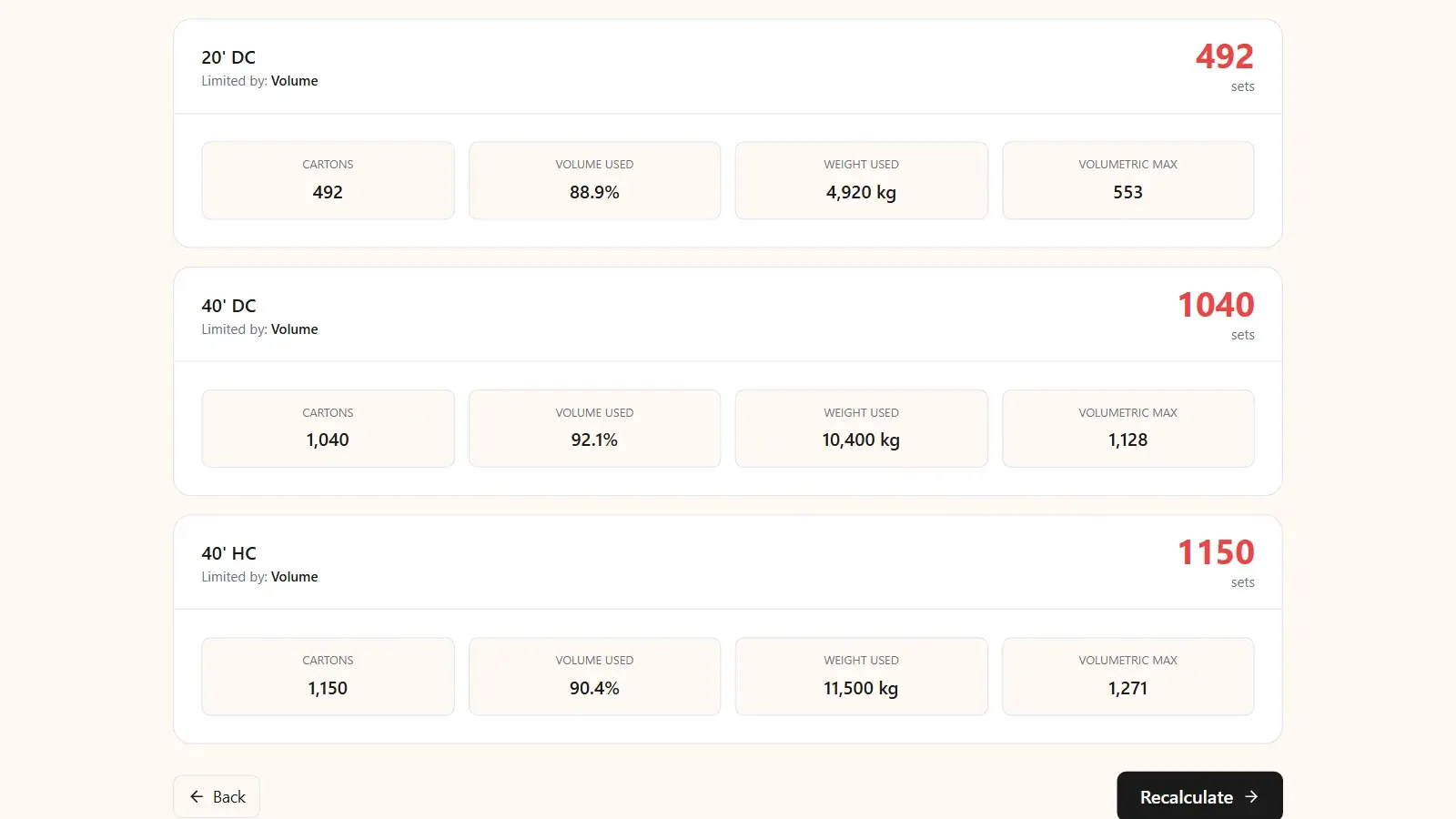
- The result shows units loaded, volume utilization and weight against the payload limit, with leftover units reported honestly. Rotate and zoom the 3D view to inspect each pallet; every box has exact coordinates.
- Save each pallet option to your dashboard to reopen and compare, and download a PDF load plan with 3D views, counts, utilization and weight.
Try it in the calculator, or read the guide first.
Sources & method
- Engine data. A 40×30×25 cm carton, 5 kg, packed onto each pallet template with a 2 m cargo stack (pallet deck excluded), Kubova engine, measured 2026-06-08. Envelope fill and boxes per square metre are our arithmetic from those counts. The 20 ft example is illustrative: geometric floor counts with no loading clearance, multiplied by the measured per-pallet counts.
- EPAL Euro pallet: 1,200 × 800 × 144 mm, about 25 kg, 1,500 kg safe working load, at most 5,500 kg on the bottom pallet when stacking laden pallets, heat-treated to ISPM 15 since 1 January 2010.
- EPAL 3 pallet: 1,200 × 1,000 × 144 mm, about 30 kg, 1,500 kg safe working load, at most 4,500 kg on the bottom pallet when stacking.
- EPAL CP5 pallet: 1,140 × 760 × 138 mm.
- IPPC: ISPM 15: the standard on regulating wood packaging material made from raw wood in international trade, including dunnage; processed wood such as plywood is excluded.
- IPPC: guide to regulating wood packaging material (2023): wood packaging includes pallets, crates and dunnage, and the ISPM 15 mark may only be applied to wood packaging treated in accordance with the standard.
- Maersk dry container specifications (PDF): example 20 ft standard interior of 5,896 × 2,350 × 2,393 mm and a 2,274 mm door height for 20 ft and 40 ft standard boxes. Interiors vary by carrier and container series.